PRODUCT REVIEW
Best Tower Fans in India 2026
Philips CX5535 vs Symphony Surround-i: our top picks among 5 tower fans. BLDC vs induction, noise level, airflow, and the best buy under ₹15,000.
 By Naveen Bhavnani
Updated
By Naveen Bhavnani
Updated
As an Amazon Associate we earn from qualifying purchases. We could also earn a fee through some links when you click on them.

Tower fan picks by price tier
Already covered the winner above — here are the picks for specific needs.

Symphony Surround-i Bladeless Tower Fan

Symphony Surround B BLDC Bladeless Tower Fan

Bajaj Snowvent Tower Fan
Tower fans compared on noise
How the shortlist stacks up. Scroll sideways on mobile.
| Product | Airflow | Noise | Power | Price | Deal |
|---|---|---|---|---|---|
| Philips CX5535/11 | Moderate (bladeless) | 28 dB (quietest) | 40W | Rs.8,950 | Check Price |
| Symphony Surround-i | 382 CFM (highest bladeless) | Moderate at high speed | 135W | Rs.6,991 | Check Price |
| Symphony Surround B BLDC | Good (bladeless BLDC) | < 43 dB | Low (BLDC) | Rs.8,491 | Check Price |
| Bajaj Snowvent | 42 CMM (strong) | Loud at high speed | 150W | Rs.3,299 | Check Price |
| V-Guard Veemagik Neo | 2401 CFM (highest overall) | Very loud at high speed | 60-70W (est.) | Rs.3,590 | Check Price |
| Russell Hobbs RTF4800 | Not disclosed | 50 dB | 60W DC | Rs.8,290 | Check Price |


Before You Buy: What Tower Fans Can and Cannot Do
Not a ceiling fan replacement
Ceiling fans move 7,000-15,000 m3/hr across a room. Even the strongest tower fan in this comparison (V-Guard at 2401 CFM) is a fraction of that - and it delivers it in one direction.
Moves air, does not cool it
A tower fan circulates existing room air. At 40 degrees in May, it circulates 40-degree air. It is not an air cooler and not an AC substitute.
Best within 6-10 feet range
Symphony claims 25 feet at max speed, which is true. But at medium speeds where noise is acceptable, plan for 6-10 feet of effective comfort range.
Best use: AC companion or evening breeze
Paired with AC, a tower fan distributes cool air better. In cooler evenings or monsoon season, it is excellent standalone. Set expectations accordingly.
Tower fan reviews: airflow, noise and power draw
Specs, the honest pros and cons, and who each one is for.
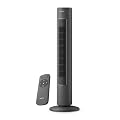
Philips CX5535/11 Bladeless Tower Fan with Remote
- Height
- 105 cm (41.3 inches)
- Design
- Bladeless
- Noise
- 28 dB (quietest)
- Power
- 40W
- Speeds
- 3 + Sleep mode
- Motor
- Copper motor
- Aromatherapy
- Yes (unique)
- Warranty
- 2+1 years (best)
- + The Philips CX5535/11 earns the Best Overall title primarily because of one number: 28dB. That is quieter than a whisper (30dB) and quieter than a library (40dB). When you are trying to sleep and every other fan sounds like a distant highway
- + the Philips is genuinely almost silent at speed 1-2. The copper motor delivers consistent airflow without the voltage sensitivity that cheaper motors exhibit. The 2+1 year warranty is the best in this category by a considerable margin. The aromatherapy box is a thoughtful addition - a few drops of eucalyptus oil during monsoon season genuinely improves the experience. At 40W
- + the electricity cost is minimal. The bladeless design is easy to clean
- + and the Philips brand means you can walk into a service centre in most Indian cities without drama.
- - Here is the honest part that most reviews skip: the Philips CX5535/11 does not move as much air as conventional tower fans or even the Symphony Surround-i. If you are expecting it to cool you down on a 40-degree afternoon
- - it will disappoint you - it circulates air gently rather than blasting you with a powerful stream. At maximum speed
- - the noise increases noticeably beyond its 28dB claim. The oscillation angle is limited compared to the 180-degree Symphony Surround B. With 2,990 reviews averaging 3.8 stars
- - there is a meaningful minority of users who find the airflow underwhelming for the price. At Rs.8,950
- - it is the most expensive in the budget-to-mid-range segment. This is a premium product for a specific use case: quiet
- - personal-zone cooling for people who value silence over raw power.
Symphony Surround-i Bladeless Tower Fan
- Air Volume
- 650 m3/hr (382 CFM)
- Air Throw
- 25 feet
- Power
- 135W (high)
- Oscillation
- 45 degree swivel
- Control
- Touchscreen + Remote
- Filter
- Dust filter included
- Compatible
- Inverter safe
- Rating
- 3.4 stars
The Symphony Surround-i is the most powerful bladeless tower fan in this comparison, and it earns the Best Bladeless title on pure airflow credentials. 650 m3/hr (382 CFM) from a bladeless design is genuinely impressive - achieved by Symphony's powerful 135W motor pushing air through the ring amplifier. The 25-foot air throw at maximum speed is real, verified by user feedback. The dual control via touchscreen panel plus full-touch remote is convenient and responsive. The built-in dust filter is a practical addition. Symphony's Indian service network is established and reliable. Honest concern: The 3.4-star rating from 578 reviews reflects a real pattern of complaints - primarily the oscillation mechanism causing the fan to shake visibly during swivel, mixed build quality, and 135W power consumption that adds to electricity bills. The standard Surround-i is noisier than the Philips and the Surround B BLDC at high speeds.
- + The Symphony Surround-i is the most powerful bladeless tower fan in this comparison. The 25-foot air throw at maximum speed is real - you can feel it from across a medium-sized room. The 382 CFM figure is the highest among bladeless options reviewed here. The touchscreen panel plus remote control combination is genuinely convenient
- + and the dust filter is a practical addition that most fans skip. Symphony's established Indian service network means warranty support is accessible. At Rs.6,991
- + it sits at a reasonable price for a bladeless fan with this level of airflow. The inverter compatibility is useful during power fluctuations common in many Indian cities and towns.
- - The 3.4-star rating from 578 reviews is a significant concern - that is below the typical acceptable threshold for a product recommendation. The most common complaint is the oscillation mechanism causing the fan to shake noticeably while rotating - users describe it as visibly wobbly during swivel
- - which is not ideal at Rs.6,991. The 135W power consumption is the highest in this comparison - running it 8 hours daily adds roughly Rs.226 to your monthly electricity bill. Remote batteries are not included
- - which feels like a deliberate cost cut at this price point. The 45-degree oscillation is narrower than the Symphony Surround B's 180-degree rotation. Build quality reviews are mixed
- - with some users reporting noise developing after a few months. If the 3.4-star rating were higher
- - this would be an easy recommendation - the specs are compelling. At 3.4
- - proceed with cautious expectations.
Symphony Surround B BLDC Bladeless Tower Fan
- Motor
- BLDC (energy saving)
- Design
- Bladeless
- Oscillation
- 180 degree (widest)
- Noise
- Less than 43 dB
- Speeds
- 7 levels
- Timer
- Up to 7 hours
- Control
- Touch + Remote
- Warranty
- 1 year
The Symphony Surround B BLDC addresses the standard Surround-i's biggest weakness: energy consumption. The BLDC motor uses 30-40% less electricity while delivering broadly comparable airflow performance. The 180-degree auto rotation is the widest in this entire comparison - the fan sweeps a full half-circle, genuinely covering more of a room than the 45-degree Surround-i. The 7 speed levels offer finer control than the 3-speed budget fans. The sub-43dB noise at medium speeds is acceptable for bedroom use - quieter than the standard Surround-i at the same settings. Honest reality: At Rs.8,491, this is pricier than the standard Surround-i and shares the same 3.4-star family rating. The build quality concerns from the Symphony range carry over. The 1-year warranty is shorter than the Philips's 2+1 years. If you value energy efficiency and wide oscillation over the quieter, better-warranted Philips, this is worth considering.
- + The Symphony Surround B BLDC solves the biggest complaint about the standard Surround-i: power consumption. The BLDC motor delivers the same general airflow capability while using 30-40% less electricity. The 180-degree auto rotation is genuinely impressive and the widest in this entire comparison - the fan sweeps a full half-circle
- + covering corners that a 45-degree swivel would miss entirely. Seven speed levels give you fine-grained control that 3-speed fans cannot match. For someone who runs the fan continuously during sleep or work hours
- + the BLDC motor efficiency adds up meaningfully over a summer. The sub-43dB noise is acceptable for bedroom use at medium speeds. Touch plus remote dual control is standard at this price. The bladeless design stays consistently clean-looking.
- - At Rs.8,491
- - the Symphony Surround B BLDC is priced higher than the standard Surround-i while sharing the same 3.4-star rating and some of the same build quality concerns from the Symphony range. The BLDC version does not fully escape the oscillation shakiness complaints seen in the standard Surround-i. The 1-year warranty is shorter than Philips's 2+1 years
- - which is a genuine drawback at this price. The bladeless CFM figures are not prominently disclosed for this model
- - making it harder to compare directly with the V-Guard or Bajaj on raw airflow. If the build quality issues in the Symphony family concern you
- - the Philips at Rs.8,950 offers better brand confidence with a superior warranty
- - for only Rs.459 more.
Bajaj Snowvent Tower Fan
- Air Delivery
- 42 CMM
- Power
- 150W
- Speeds
- 3 settings
- Design
- Conventional bladed
- Body
- Thermoplastic
- Oscillation
- None
- Remote
- No
- Warranty
- 1 year
The Bajaj Snowvent's primary appeal is simple: it is Rs.3,299 and carries the Bajaj name. In India, Bajaj as an appliance brand represents decades of reliable, repairable products with service centres in virtually every town and city. If something goes wrong, you can fix it. That is a meaningful differentiator at the budget end where unknown brands sell similar-looking products with no after-sales support. The 42 CMM (roughly 1,483 CFM) air delivery is solid for its price. The thermoplastic body is lightweight and easy to move. Honest limitations: This is a no-frills fan. No remote, no oscillation, no sleep mode, no timer, no touchscreen. At 150W it consumes more electricity than the Philips (40W) or Russell Hobbs (60W). It is notably loud at high speed. Do not buy this expecting the features you see in premium tower fans. Buy it because you want basic, reliable airflow from a brand you can trust, at the lowest price in this comparison.
- + The Bajaj Snowvent is the budget pick from a brand that virtually every Indian household knows and trusts. At Rs.3,299
- + it is the most affordable option in this comparison. Bajaj's nationwide service centre presence means if something goes wrong
- + you can get it repaired without navigating grey-market warranty processes. The 42 CMM (roughly 1,483 CFM) air delivery is strong - this fan moves a respectable amount of air for its price point. The thermoplastic body is lightweight enough to carry from room to room easily. If you need a functional tower fan on a tight budget from a reliable Indian brand
- + the Bajaj Snowvent does what it says on the box.
- - The Bajaj Snowvent is a basic fan
- - and it shows. There is no remote control
- - no oscillation mechanism
- - no sleep mode
- - no timer
- - and no touchscreen. You get 3 speeds and a power switch. At 150W
- - it is the highest power consumer in this comparison despite not being the most powerful in CFM terms - that efficiency gap reflects older motor technology versus BLDC competitors. It is noticeably loud at high speed. The design is utilitarian rather than attractive. If you place this in a living room or bedroom expecting a modern appliance
- - the reality will disappoint visually. This is a workhorse
- - not a showpiece. For garages
- - workshops
- - kitchens
- - or supplementary cooling in utility spaces
- - it earns its keep. For bedroom use where you want a quiet
- - remote-controlled experience
- - look elsewhere.
V-Guard Veemagik Neo Tower Fan
- Airflow
- 2401 CFM (highest)
- RPM
- 1300 RPM
- Sweep
- 43.5 cm
- Safety
- Thermal protector
- Speeds
- 3 settings
- Remote
- No
- Oscillation
- None
- Warranty
- 18 months
The V-Guard Veemagik Neo delivers one thing exceptionally: raw airflow. 2401 CFM is the highest number in this entire comparison - it beats the Symphony Surround-i's 382 CFM by a factor of six. The 1300 RPM motor is powerful. The built-in thermal protector is a safety feature that prevents motor burnout during extended use, which is commendably practical. V-Guard is a highly trusted brand in India, particularly in South India where it started, with decades of electrical product expertise. The 18-month warranty is better than the standard 1-year. At Rs.3,590, the price-to-airflow ratio is hard to beat. Critical concern: The durability reports cannot be dismissed. Multiple user reviews specifically mention the fan failing around 10-11 months - just before the 18-month warranty would still cover it, but enough time has passed that many people no longer have the receipt handy. If the initial batch quality issues have been resolved in newer production runs, this could be a strong budget pick. Check recent reviews before purchasing.
- + The V-Guard Veemagik Neo has one thing going for it that nothing else in this comparison can match: 2401 CFM of raw airflow. That is a genuinely powerful fan. The 1300 RPM motor is strong
- + and the built-in thermal protector adds a useful safety layer against overheating during long continuous use. V-Guard is among the most trusted electrical brands in India
- + particularly in South India
- + with decades of reliability track record. The 18-month warranty is better than the standard 1-year most competitors offer. At Rs.3,590
- + it is marginally more expensive than the Bajaj Snowvent but delivers more raw airflow.
- - Here is the concern that cannot be overlooked: multiple reviews report the fan breaking down around the 10 to 11 month mark - just before the warranty expires. This pattern of early failure
- - while not universal
- - is concerning enough that we cannot recommend this without the caveat. The V-Guard Veemagik Neo is very loud at high speed - 2401 CFM of airflow does not come quietly. There is no remote control and no oscillation feature. The basic 3-speed control offers no sleep mode
- - no timer
- - and no smart features. For bedroom use
- - the noise level rules it out. For a utility space where you need maximum airflow on a budget
- - it is compelling - but keep your purchase receipt and be aware of the durability reports.
Russell Hobbs RTF4800 Tower Fan
- Height
- 48 inches (122 cm)
- Motor
- DC (energy efficient)
- Power
- 60W
- Display
- LED digital
- Timer
- 12 hours (longest)
- Ionizer
- Yes
- Noise
- 50 dB
- Rating
- 3.2 stars
The Russell Hobbs RTF4800 has the most distinctive specification in this comparison: 48 inches (122 cm) of height. Every other fan here is 40-42 inches. That additional 6-8 inches of height genuinely improves vertical airflow distribution, particularly in rooms with 10+ foot ceilings. The DC motor runs 30-40% more efficiently than conventional AC motors. The 12-hour programmable timer is the longest available in this comparison - genuinely useful for overnight use without waking to turn it off. The LED display is clear and practical. The ionizer adds mild air freshening. However, the 3.2-star rating from 253 reviews is the lowest in this comparison, and at Rs.8,290, that is a significant concern. Users report airflow that does not match the price expectation, limited Russell Hobbs service support in smaller Indian cities, and build quality that disappoints at this price point. No CFM figure is disclosed. The ionizer's effectiveness is debatable.
- + The Russell Hobbs RTF4800's defining advantage is height. At 48 inches
- + it is the tallest fan in this comparison
- + and that genuinely matters for vertical air distribution - the airflow column reaches higher
- + covering standing adults and high window-level air movement better than shorter 40-inch fans. The DC motor is 30-40% more energy efficient than conventional AC motors. The 12-hour programmable timer is the longest available in this comparison - you can set it before bed and it will shut off in the morning without waking you up. The LED display provides clear visual feedback of current settings. The ionizer adds mild air freshening capability.
- - A 3.2-star rating from 253 reviews is the lowest in this comparison
- - and it is a significant red flag. At Rs.8,290
- - you are paying a premium price for a product that a meaningful proportion of buyers find disappointing. The concerns include build quality
- - airflow that does not justify the price
- - and limited after-sales support for the Russell Hobbs brand in smaller Indian cities. No CFM rating is disclosed
- - which is unusual for a product at this price - when brands know their airflow figures are strong
- - they advertise them. The ionizer's actual effectiveness is debatable and not independently verified. Limited availability compared to Philips
- - Bajaj
- - or V-Guard makes finding service centres harder. The 3.2-star rating tells you to proceed with caution - verify it is in stock on Amazon.in and check recent reviews before purchasing.
Which tower fan to buy
Here is who each pick is for, based on the comparison above.
Philips CX5535/11 Bladeless Tower Fan with Remote · Rs.8,950
Industry-leading 28dB silence, copper motor, aromatherapy, 2+1 year warranty from Philips
Check Price on Amazon →Symphony Surround-i Bladeless Tower Fan · Rs.6,991
Highest CFM (382), 25ft air throw, touchscreen + remote dual control from Symphony
Check Price on Amazon →Symphony Surround B BLDC Bladeless Tower Fan · Rs.8,491
BLDC motor saves 30-40% power, 180-degree auto rotation, 7 speed levels
Check Price on Amazon →Bajaj Snowvent Tower Fan · Rs.3,299
Bajaj brand trust at just Rs.3,299 with nationwide service network
Check Price on Amazon →How to choose a tower fan: BLDC or induction
-
What a Tower Fan Can and Cannot Do (Read This First)
Let us be straightforward before you spend any money: a tower fan is NOT a replacement for your ceiling fan, air cooler, or AC. If someone told you a tower fan would keep your entire 200 sq ft bedroom cool on a 42-degree May afternoon in Delhi, they were wrong. What a tower fan actually does: it moves air in a focused, directional stream across a room. The tall, slim form factor means the airflow column covers more vertical height than a table fan - which is genuinely useful if you are standing, sitting, or lying at different positions. The oscillation feature spreads that airflow in a sweeping arc. Effective range depends entirely on the model. Budget models like Bajaj Snowvent push a lot of air but in a wide, uncontrolled stream. Premium bladeless models like Philips CX5535 deliver quieter, more directed airflow but with less raw power. Symphony Surround-i claims 25-foot air throw - which is real at maximum speed, but at that speed it draws 135W and makes some noise. Tower fans work best in the following situations: as an AC companion to distribute cool air evenly, in the evenings and mornings when outdoor temperature drops below 35 degrees, at your desk or bedside within 6-8 feet, and in rooms where ceiling fan installation is not feasible. They will disappoint you if you expect them to cool a room on their own during peak summer. -
Key Specifications to Evaluate
1. Airflow (CFM or CMM): This is the most important number. CFM (Cubic Feet per Minute) tells you how much air the fan moves. V-Guard Veemagik Neo leads at 2401 CFM - it is a genuinely powerful fan. Symphony Surround-i delivers 382 CFM from a bladeless design. Bajaj Snowvent claims 42 CMM (roughly 1483 CFM). Compare this to a typical BLDC ceiling fan at 210-220 CMM (7400-7770 CFM) - you can see tower fans are in a different league. 2. Power Consumption: Ranges from 40W (Philips) to 150W (Bajaj Snowvent). BLDC motor models like Symphony Surround B use significantly less electricity than conventional AC motors. At 8 hours daily use, a 150W fan costs roughly Rs.252 per month versus Rs.67 per month for a 40W model (at Rs.7/unit). 3. Noise Level: Philips claims 28dB at minimum speed - genuinely whisper-quiet and the best in this comparison. Bajaj and V-Guard are loud at high speeds (60dB+). For bedroom use, look for models with a dedicated Sleep mode that reduces speed automatically. 4. Oscillation: How far the fan head sweeps. Symphony Surround B offers 180-degree auto rotation - the widest in this list. Bajaj and V-Guard have fixed direction with no oscillation. Philips has limited oscillation angle. 5. Warranty: Philips offers 2+1 years (best). V-Guard gives 18 months. Bajaj offers standard 1 year. Warranty matters more for bladeless designs which have more complex mechanisms. -
Bladeless vs Conventional Tower Fan - Honest Comparison
Bladeless tower fans (Philips CX5535, Symphony Surround-i, Symphony Surround B) look spectacular but come with real trade-offs. What bladeless does better: They are safer around children and pets (no exposed moving blades). They are easier to clean - no grille gaps for dust to accumulate in. They look genuinely premium and modern. At low speeds, the airflow is smoother and quieter because there are no blade-chop turbulence patterns. What bladeless does NOT do better: Raw airflow. A conventional bladed tower fan with the same motor power will move more air than a bladeless design. The bladeless mechanism draws air in from the base and amplifies it through a ring - this is inherently less efficient than open blades. Symphony compensates with a 135W motor (more power), but this also means higher electricity bills. Conventional bladed fans (Bajaj Snowvent, V-Guard Veemagik Neo): These move significantly more air per watt of power. They are louder. They are cheaper. They look more ordinary. If you want raw cooling performance and do not mind the aesthetics or the noise, a conventional tower fan is more effective per rupee spent. Our honest take: bladeless tower fans are worth the premium if you specifically value the quiet operation, the safe design for families with young children, or the premium aesthetics in your bedroom or living room. They are not worth it if maximum airflow is your primary goal. -
Price Tier Guide - What You Get at Each Level
Budget (Rs.3,000 to Rs.4,500): You are looking at Bajaj Snowvent and V-Guard Veemagik Neo. These are conventional bladed fans with strong airflow, no remote control, basic 3-speed control, and louder operation. They serve their purpose - moving a lot of air - but they are not what you imagine when you picture a modern tower fan. Good for garages, kitchens, or utility spaces. Not ideal for bedrooms. Mid-range (Rs.6,500 to Rs.7,500): Symphony Surround-i at Rs.6,991 is the entry point to bladeless technology with real power. You get a touchscreen, remote, dust filter, and 25-foot air throw. The trade-offs are higher power consumption and the known oscillation shaking issue. Premium (Rs.8,000 to Rs.9,500): This is where Philips CX5535/11, Symphony Surround B BLDC, and Russell Hobbs RTF4800 live. You get quieter operation, better build quality, and features like BLDC motors, ionizers, or aromatherapy. Russell Hobbs at Rs.8,290 is the best-value tall fan with a DC motor. Philips at Rs.8,950 is the quietest option available. Symphony Surround B at Rs.8,491 offers BLDC efficiency with 180-degree rotation. Honest advice: The mid-range sweet spot for most Indian households is around Rs.6,500 to Rs.8,500. Below that, you are buying a basic blower. Above Rs.9,000, the incremental improvements become marginal.
Frequently asked questions
Which is the best tower fan in India overall?
Can a tower fan replace my ceiling fan?
Which is the quietest tower fan for bedroom use in India?
Is a bladeless tower fan worth the extra cost?
How much electricity does a tower fan consume per month?
Philips CX5535 vs Symphony Surround-i - which should I choose?
Do tower fans work well in Indian summers (40+ degrees)?
What warranty should I expect and which brand offers the best?
You may also like
More guides and reviews to help you decide.
Honest reviews of the best 3D air circulation tower fans in India 2026 — NUUK HALO v2, DOMESTICA Breezo, FASTRON & HIFRESH compared on airflow, noise.
Read more →Compare the best air coolers in India for 2026 under ₹7,000, ₹10,000 and ₹15,000 — personal, tower and desert picks with specs, prices and pros & cons.
Read more →7 best BLDC ceiling fans in India 2026 compared — Superfan SuperA1 (WWCD winner, 49 dB, 385 RPM), atomberg Studio Nexus smart IoT, Erica Nuvo, Renesa.
Read more →Best pedestal fans in India 2026 compared — BLDC and traditional picks from ₹2,419 to ₹4,499.
Read more →Find the best table fan under 2000 in India 2026. Research-based reviews with detailed comparisons, prices, pros & cons to help you pick the right one.
Read more →BLDC motors explained: electronic commutation, why there is no rotor current, and how BEE actually rates a fan. With the 2026 service value table.
Read more →