
PRODUCT REVIEW
Best 100W Multi-Port GaN Fast Charger in India 2026
Compare the 12 best 100W multi-port GaN fast chargers in India 2026 — UGREEN Nexode, Ambrane, Belkin, Honeywell & more, with prices, ports.
 By Naveen Bhavnani
Updated
By Naveen Bhavnani
Updated
As an Amazon Associate we earn from qualifying purchases. We could also earn a fee through some links when you click on them.

GaN charger picks for every budget
Already covered the winner above — here are the picks for specific needs.

Belkin BoostCharge Pro 200W 4-Port GaN Charger

Portronics Adapto 100 Pro 100W GaN Charger (4-Port)

Belkin BoostCharge Pro 108W 4-Port GaN Charger
GaN chargers compared on wattage
How the shortlist stacks up. Scroll sideways on mobile.
| WWCD Score | Product | Ports | Max Single-Port | Total | Rating | Warranty | Price | Deal |
|---|---|---|---|---|---|---|---|---|
| 9.2/10 | UGREEN Nexode 100W (4-Port) | 3C + 1A | 100W | 100W | 4.6 | 2 years | ₹5,947 | Check Price |
| 8.9/10 | Ambrane 150W RAAP HUB 150 (4-Port) | 3C + 1A | 100W | 150W | 4.3 | 6 months | ₹4,499 | Check Price |
| 8.8/10 | Ambrane 100W RAAP H100 (4-Port) | 3C + 1A | 100W | 100W | 4.3 | 6 months | ₹4,799 | Check Price |
| 8.7/10 | INICIO 140W 6-Port Desktop | 3C + 3A | 100W | 140W shared | 4.2 | — | ₹3,699 | Check Price |
| 8.7/10 | Belkin BoostCharge Pro 200W (4-Port) | 4C | 140W | 200W | 4.1 | 2 years | ₹11,399 | Check Price |
| 8.6/10 | Honeywell Zest 100W (4-Port) | 3C + 1A | 100W | 100W | 4.0 | 3 years | ₹6,236 | Check Price |
| 8.5/10 | T Teclusive 100W Display (4-Port) | 2C + 2A | 100W | 100W (C+C 95W) | 4.2 | 1 year | ₹3,299 | Check Price |
| 8.5/10 | Portronics Adapto 100 Pro (4-Port) | 3C + 1A | 100W | 100W | 4.2 | 6 months | ₹2,599 | Check Price |
| 8.4/10 | Belkin BoostCharge Pro 108W (4-Port) | 2C + 2A | 100W | 108W | 4.1 | 2 years | ₹6,679 | Check Price |
| 8.4/10 | GM G+ DisplayPulse 100W | C + A | 100W | 100W | 4.2 | 1 year | ₹3,699 | Check Price |
| 8.4/10 | INICIO 100W 4-Port (Wall) | 3C + 1A | 100W | 100W | 4.4 | — | ₹2,564 | Check Price |
| 8.3/10 | Nu Republic Cybotron 100W (4-Port) | 2C + 2A | 100W | 100W | 4.0 | 6 months | ₹2,147 | Check Price |




Before you buy: 3 things that decide real-world speed
“100W total” is not “100W per port.” Almost every charger here hits 100W only on a single USB-C port with a 5A cable. Plug in a second device and the budget is shared — a laptop can drop to ~65W while phones split the rest. Need full laptop speed and other devices at once? Step up to the 150W Ambrane or the 140W INICIO.
A 5A (100W) e-marked cable is mandatory. Many ordinary USB-C cables cap at 60W and will silently throttle you. Some chargers bundle a cable (Portronics, Nu Republic, Ambrane); the UGREEN Nexode and both Belkins do not.
Check for genuine India reviews. Several big-name SKUs (some Anker, Lenovo, Baseus and Rocoren listings) carry thousands of global ratings but none from India — imported units with possible plug/voltage quirks and no local warranty. Every charger in this list has a real Indian track record.
100W GaN charger reviews: ports, wattage and heat
Specs, the honest pros and cons, and who each one is for.
UGREEN Nexode 100W USB-C GaN Charger (4-Port)
The reference-grade 100W multi-port charger for Indian homes and desks.
- Ports
- 4 (3× USB-C + 1× USB-A)
- Max Single-Port
- 100W (USB-C, 5A cable)
- Total Wattage
- 100W
- Protocols
- PD 3.0 · PPS · Samsung SFC 2.0
- Weight
- 210 g
- Certification
- BIS
- Cable
- Not included
- Warranty
- 2 years
The most complete pick: true single-port 100W, four ports, the broadest protocol support and the best reviews in the field. You'll need to add a 5A cable, but nothing else here matches its all-round balance.
- + Genuine 100W on a single USB-C port
- + Charges 3-4 devices at once with sensible power sharing
- + Widest protocol support here (PD 3.0 / PPS / Samsung SFC 2.0)
- + Best Amazon rating in the field at 4.6
- + 2-year warranty and BIS-certified build
- - No charging cable in the box
- - Gets warm under sustained laptop load
- - Pricier than Indian-brand 4-port rivals
- - One isolated floating-ground shock report
Ambrane 150W GaN Charger RAAP HUB 150 (4-Port)
150 watts of headroom so nothing throttles when every port is busy.
- Ports
- 4 (3× USB-C + 1× USB-A)
- Max Single-Port
- 100W (USB-C)
- Total Wattage
- 150W
- GaN
- Yes
- Cable
- Long cable included
- Origin
- Vietnam
- Warranty
- 6 months
The pick for power users juggling a laptop and several devices: the 150W budget means far less throttling than 100W-total rivals, and India reviews back up its low-heat, all-ports-working reliability. Just a short warranty and a bulkier body.
- + 150W total — most headroom here for charging 3-4 power-hungry devices at once
- + Holds 100W on a single USB-C for laptops
- + India reviews praise low heat and all ports working reliably
- + Long cable included in the box
- + Good value for a 150W GaN unit
- - Only a 6-month warranty
- - Larger desk-oriented body that is not travel-friendly
- - Smaller review base (19 ratings) than top sellers
- - No proprietary vivo/iQOO/OPPO flash-charge support
Ambrane 100W GaN Charger RAAP H100 (4-Port)
The cool-running, fuss-free 100W workhorse from a trusted Indian brand.
- Ports
- 4 (3× USB-C + 1× USB-A)
- Max Single-Port
- 100W (USB-C)
- Total Wattage
- 100W
- GaN
- Yes
- Weight
- 200 g
- Cable
- Multi-connector cable included
- Warranty
- 6 months
A dependable 100W 4-port that India reviewers love for staying cool under load. Watch for its frequent sale pricing — at a discount it's outstanding value; at MRP the 6-month warranty is the only real gripe.
- + Consistently praised in India reviews for fast charging that doesn't heat
- + 100W single-port plus 4 ports for laptop + phones together
- + Bundled multi-connector cable adds value
- + Frequently discounted heavily in sales
- + Trusted Indian brand with easy support
- - Only a 6-month warranty
- - Sticker price is high relative to its frequent sale price
- - No proprietary vivo/iQOO flash-charge support
- - USB-A port tops out well below the USB-C ports
INICIO 140W 6-Port GaN Desktop Charger
One hub, six ports — built to power a whole desk at once.
- Ports
- 6 (3× USB-C + 3× USB-A)
- Max Single-Port
- 100W (USB-C)
- Total Wattage
- 140W shared
- GaN
- Yes
- Form Factor
- Desktop hub
- Extras
- Intl plugs + extension + wattage display
The go-to if you need to charge many devices from one spot: six ports, 100W on a single USB-C and a handy display. Just temper expectations on long-term reliability and remember the 140W is shared across ports.
- + Six ports (3× USB-C + 3× USB-A) to charge an entire desk from one hub
- + 100W on a single USB-C plus a 140W shared budget
- + Live wattage display and bundled international plugs/extension
- + Great value for a 6-port desktop charger
- + Compact for the number of ports it offers
- - Reliability concerns — several India reviews report failures within months
- - Total 140W is shared so two fast-charge devices will split the budget
- - No printed support contact which makes warranty claims harder
- - Desktop form factor that is not for travel
Belkin BoostCharge Pro 200W 4-Port GaN Charger
A 200W four-USB-C powerhouse that can fast-charge even 140W laptops.
- Ports
- 4 (4× USB-C PD)
- Max Single-Port
- 140W (PD 3.1 EPR)
- Total Wattage
- 200W
- PPS
- Yes (PD 3.1 EPR)
- Form Factor
- Desktop (5 ft cord)
- Cable
- Not included
- Warranty
- 2 years
The most capable charger here on paper — 200W, 140W single-port and four USB-C ports with PD 3.1 EPR — ideal for a multi-laptop desk. The catch is reliability: a few India buyers hit early failures, so lean on the 2-year warranty and buy only if you need this much power.
- + Most powerful here — 200W total with a 140W single-port (PD 3.1 EPR)
- + Four full USB-C PD ports for multiple laptops/phones at once
- + Broadest protocol support (PD 3.1 EPR + PPS)
- + Premium Belkin build with a 2-year warranty and eco materials
- + Charges a MacBook Pro 16 0-50% in about 30 minutes
- - Reliability is the concern — several India reviews report failure within 2-6 months
- - Slow Belkin replacement/service experience reported
- - Expensive at ₹11399 and the USB-C cable isn't included
- - Bulky desktop unit with a fixed 5ft cord
- - Thin India review base (16 ratings)
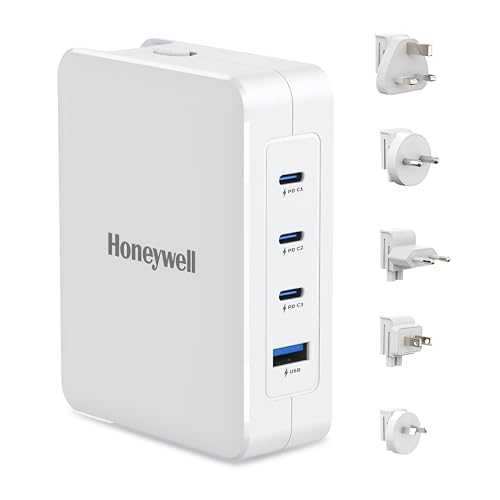
Honeywell Zest 100W GaN Charger (4-Port, Switchable Plugs)
The globe-trotter's 100W charger — five-country plugs and a 3-year warranty.
- Ports
- 4 (3× USB-C + 1× USB-A)
- Max Single-Port
- 100W (USB-C)
- Total Wattage
- 100W
- PPS
- Yes
- Plugs
- Switchable EU/UK/IN/US/CN
- Weight
- 95 g
- Certification
- BIS
- Warranty
- 3 years
Buy it for travel and the 3-year warranty: switchable plugs and PPS make it uniquely versatile abroad. Just know that multi-device reliability is its weak spot in India reviews, so it's better as a 1-2 device travel charger.
- + Class-leading 3-year warranty from a globally trusted brand
- + Switchable EU/UK/IN/US/CN plugs — best here for international travel
- + PD 3.0 + PPS with BIS certification
- + Lightweight at 95g
- + 100W on a single USB-C port
- - Multiple India reviews report ports failing when several devices are connected
- - Heavy-feeling plug can slip out of loose wall sockets
- - Some defective units with intermittent on/off and slow support
- - Priciest in the value tier despite mid-pack reliability
T Teclusive 100W GaN Charger with Display (4-Port)
Multi-device charging with a live wattage display, at a value price.
- Ports
- 4 (2× USB-C + 2× USB-A)
- Max Single-Port
- 100W (C1 or C2)
- Total Wattage
- 100W (C+C 95W)
- Display
- Yes (voltage/wattage)
- Protocols
- PD · QC4.0+ · QC3.0 · FCP · SCP
- Warranty
- 1 year
A strong value all-rounder: genuinely good at charging several devices at once, with a useful display. Quality control is the caveat — a few users hit defective units — so register the 1-year warranty promptly.
- + Excellent simultaneous multi-device charging (Mac + iPhone + iPad together)
- + 100W available on either USB-C port
- + Live display shows real-time voltage/wattage
- + Broad protocol support (PD / QC4.0+ / QC3.0 / FCP / SCP)
- + Keenly priced with a 1-year warranty
- - A reviewer reported a current shock and a unit failing within 15 days
- - Loose 2-pin fitment on some units
- - It's a corded tabletop charger rather than a wall plug
- - USB-A ports cap at 30W
Portronics Adapto 100 Pro 100W GaN Charger (4-Port)
The cheapest complete 100W kit — charger and cable in the box.
- Ports
- 4 (3× USB-C PD + 1× USB-A)
- Max Single-Port
- 100W (USB-C)
- Total Wattage
- 100W
- PPS
- Yes
- Cable
- 1.5 m USB-C included
- Warranty
- 6 months
The best pick if you want a 100W charger and cable for the least money from a known brand. It's a fine 1-2 device charger; just don't expect full simultaneous fast charging across all four ports.
- + Cheapest branded 100W 4-port that includes a 1.5m USB-C cable
- + 100W single-port for laptops
- + Compact and genuinely pocketable
- + PD + PPS support from a well-known Indian brand
- + Great price-to-feature ratio at ₹2599
- - Doesn't fast-charge all ports simultaneously — drops speed when loaded
- - Heat complaints under heavier loads
- - Isolated reports of a port failing / power cycling
- - Only a 6-month warranty
Belkin BoostCharge Pro 108W 4-Port GaN Charger
A trusted-brand 4-port charger for an Apple-and-laptop multi-device desk.
- Ports
- 4 (2× USB-C + 2× USB-A)
- Max Single-Port
- 100W (single USB-C)
- Total Wattage
- 108W
- PPS
- No (PD 3.0 only)
- Cable
- Not included
- Warranty
- 2 years
A solid premium pick if you value Belkin's build and 2-year warranty and mostly charge Apple gear and laptops — reviewers love it for powering several devices at once. The lack of PPS (slow on Samsung flagships) and only two USB-C ports hold it back from the top tier.
- + Trusted Belkin build quality with a 2-year warranty
- + Excellent real-world multi-device charging (laptop + 2 phones + watch together)
- + 100W available on a single USB-C port
- + Two USB-A ports for older cables and accessories
- + Intelligent Power Sharing distributes power sensibly across 4 devices
- - No PPS — Samsung Galaxy flagships are capped at 25W
- - Only 2 USB-C ports (rivals offer 3) and 108W is shared across all ports
- - Runs hot when delivering maximum output
- - Some India reviews report USB-C ports failing within weeks
- - Cable not included and priced above Indian-brand rivals
GM G+ DisplayPulse 100W GaN Charger
Featherweight 100W with a live wattage display for travel.
- Ports
- Multi (USB-C + USB-A)
- Max Single-Port
- 100W (USB-C)
- Total Wattage
- 100W
- Display
- TFT real-time wattage
- Weight
- 65 g
- Warranty
- 1 year
A 65g, display-equipped 100W charger that's ideal for travellers powering one or two devices. It's let down by weaker performance and heat when you load every port, so don't rely on it as a 4-device hub.
- + Lightest charger in the field at just 65g
- + Live TFT display shows real-time charging wattage
- + 100W on a single USB-C port
- + Strong everyday value with a 1-year warranty
- + Large review base (114 ratings) for a budget unit
- - Secondary ports under-deliver power per several reviews (USB-A as low as ~7W)
- - Heats up and throttles when multiple ports are loaded
- - Polarised reviews — quality varies between units
- - Best treated as a 1-2 device charger rather than a full hub
INICIO 100W 4-Port GaN Charger (Wall)
A pocketable 100W 4-port wall charger at a budget price.
- Ports
- 4 (3× USB-C + 1× USB-A)
- Max Single-Port
- 100W (C1/C2)
- Total Wattage
- 100W
- PPS
- Yes
- GaN
- Yes
A compact, genuinely cheap 100W wall charger that's well-rated so far — but the small review base and limited stock mean it's a slightly less proven pick than the leaders.
- + 100W single-port at one of the lowest prices here
- + Compact lightweight wall form factor
- + PD + PPS support for laptops and phones
- + Published per-port power split so you know what to expect
- + Higher star rating (4.4) than most budget rivals
- - Thin review base (only 16 ratings) — less proven
- - An isolated overheating report under load
- - Power-shares across ports when fully loaded
- - Limited stock at the time of research
Nu Republic Cybotron 100W GaN Charger (4-Port)
The budget four-output charger for phones and everyday devices.
- Ports
- 4 (2× USB-C PD + 2× USB-A QC3.0)
- Max Single-Port
- 100W (C1)
- Total Wattage
- 100W
- Protocols
- PD · PPS · QC 3.0
- Cable
- USB-C to C included
- Warranty
- 6 months
The cheapest and most-reviewed option, best suited to charging several phones and one laptop. Don't expect a true 100W on every port — single-port output is modest in practice — but for the price it's a capable everyday multi-port.
- + Cheapest charger here (₹2147) and by far the most reviewed (509 ratings)
- + Four simultaneous outputs (2× USB-C PD + 2× USB-A QC3.0)
- + Bundled USB-C cable and built-in safety protections
- + Works well for phones and a single laptop
- + Compact GaN body
- - Real single-port output is often ~45-65W in reviews — below the 100W headline
- - Per-device power drops sharply (~22.5W) when several ports are used
- - Heats up when charging a laptop
- - Lowest rating in the field (4.0) and only a 6-month warranty
Understanding the technology
GaN technology
Fast-charging protocols
Safety to look for
Which GaN charger to buy
After comparing all twelve on power, port layout, protocol support, build and price, here is who each top pick is for.
UGREEN Nexode 100W (4-Port) · ₹5,947
The safest all-round choice — true single-port 100W, the broadest protocol support (including Samsung SFC) and the best reviews in the field. Just add a 100W/5A cable.
Check Price on Amazon →Belkin BoostCharge Pro 200W · ₹11,399
When you need the most power on a desk: 200W total, a 140W single-port (PD 3.1 EPR) and four USB-C ports for charging multiple laptops at once.
Check Price on Amazon →Portronics Adapto 100 Pro · ₹2,599
The cheapest complete kit from a known brand — a 100W charger and a 1.5m USB-C cable in the box. A fine 1–2 device charger for the money.
Check Price on Amazon →Belkin BoostCharge Pro 108W · ₹6,679
The popular trusted-brand pick for an Apple-and-laptop desk, with Belkin's 2-year warranty and Intelligent Power Sharing — note no PPS for Samsung flagships.
Check Price on Amazon →How to choose a 100W GaN charger
-
“100W total” is not the same as “100W per port”
Almost every charger here is rated 100W in total, but that full 100W is usually available only on a single USB-C port with the right 5A cable. The moment you plug in a second device, the budget is shared — a laptop might drop from 100W to 65W, and phones split the rest. If you need to charge a laptop at full speed AND other devices simultaneously, look at higher-budget units (the Ambrane 150W or the 140W INICIO desktop) rather than a 100W-total charger. -
Match ports to your devices (USB-C PD vs USB-A)
Modern laptops, phones and tablets all use USB-C Power Delivery, so prioritise chargers with 3+ USB-C ports. USB-A ports are handy for older cables and accessories but are capped far lower (often 18–30W) and can't fast-charge a laptop. A 3× USB-C + 1× USB-A layout is the sweet spot for most people. -
A 5A (100W) cable is mandatory for full speed
To actually pull 100W you need an e-marked 100W/5A USB-C cable. Some chargers (UGREEN Nexode, both Belkins) don't include one; others (Portronics, Nu Republic, Ambrane) bundle a cable. Budget for a good 5A cable if it isn't in the box — a cheap cable will silently cap you at 60W. -
PPS and protocol support decide your real-world speed
PPS (Programmable Power Supply) is required for the fastest charging on Samsung Galaxy (Super Fast Charging) and many newer Androids. PD 3.0 covers iPhones, MacBooks and Windows laptops. Note that proprietary fast charging (vivo/iQOO, OPPO/OnePlus SuperVOOC, realme) generally won't hit top speeds on any universal GaN charger — those need the brand's own charger. -
Watch heat and long-term reliability
GaN runs cooler than older silicon chargers, but every unit warms up when charging a laptop under sustained load. India reviews flagged heat and occasional port failures most often on the cheapest desktop and display units. Prefer chargers with BIS certification and a real warranty, and avoid running a charger covered or in an enclosed space. -
Beware foreign-market listings with no India reviews
Several big-name chargers on Amazon.in (including specific Anker, Lenovo, Baseus and Rocoren SKUs) carry thousands of global ratings but zero reviews from India — they're imported listings. These can have mismatched plugs, voltage quirks (one charging station reportedly shuts down at India's 230V/50Hz) and no local warranty. Always check that a product has genuine 'Top reviews from India' before buying.
Frequently asked questions
What is the best 100W multi-port GaN fast charger in India?
Can a 100W multi-port charger charge my MacBook Pro and phone at the same time?
Can I charge my laptop with a multi-port USB charger?
Do I need a special cable to get 100W?
What's the difference between 65W and 100W chargers?
Will charging multiple devices slow down charging speed?
Will these chargers fast-charge my OnePlus, vivo or iQOO phone?
Is GaN technology worth the extra cost?
What does PPS mean and do I need it?
Are Indian-brand chargers (Ambrane, Portronics, Nu Republic) safe?
Why were some popular Anker and Lenovo chargers left out?
Are these chargers safe to leave plugged in overnight?
Do I need USB-C ports or are USB-A ports enough?
You may also like
More guides and reviews to help you decide.
Find the best 65W GaN charger in India 2026 from ₹999 to ₹5,947. In-depth reviews of 10 chargers including DR VAKU, Panasonic, Spigen, Ambrane, Anker, UGREEN.
Read more →Find the best multi port usb charger in India 2026. Research-based reviews with detailed comparisons, prices, pros & cons to help you pick the right one.
Read more →8 best wireless chargers in India 2026 compared — Anker MagGo Qi2 (winner), Belkin 2-in-1, Anker UFO 3-in-1, UGREEN, boAt & the GM G+ Arc value pick.
Read more →Find the best usb type-c cable in India 2026. Compare Anker, Belkin, Amazon Basics with research-based reviews, prices, pros & cons.
Read more →Find the best 20000mAh power bank in India 2026 from ₹679 to ₹2,499. Compare Xiaomi, Boat, Amazon Basics & more with in-depth reviews, prices, pros & cons.
Read more →Find the best laptop power bank charger in India 2026. Compare 65W-100W USB-C PD models for MacBook and Windows laptops, with real prices, pros & cons.
Read more →