PRODUCT REVIEW
Best Dry Irons for Everyday Ironing in India 2026
The 8 best heavy-weight dry irons in India 2026 compared — Havells Blaze 2kg (winner), Bajaj Herculo, Rico 2kg, a 3.5kg Phynix commercial press and more.

As an Amazon Associate we earn from qualifying purchases.
Best for specific needs
Already covered the top two above — here are the picks for specific needs.


Quick Comparison
How the shortlist stacks up. Scroll sideways on mobile.
| WWCD Score | Product | Weight | Wattage | Soleplate | Auto-shutoff | Rating | Price | Deal |
|---|---|---|---|---|---|---|---|---|
| 9.3/10 | Havells Blaze 2 KG Heavy Weight | 2 kg | 1250 W | American Heritage non-stick | Yes | 4.2 (5,145) | ₹1,319 | Check Price |
| 9.3/10 | Bajaj Herculo Heavy Weight | 1.7 kg | 1100 W | Duraglide non-stick | No | 4.3 (950) | ₹1,464 | Check Price |
| 9.2/10 | Rico 1000W 2KG AI13 | 2 kg | 1000 W | 3-layer non-stick | No | 4.2 (9,591) | ₹1,535 | Check Price |
| 9.2/10 | Phynix 3.5 KG Industrial | 3.5 kg | 1000 W | Cast iron (mirror) | Yes | 5.0 (1) | ₹2,199 | Check Price |
| 9.2/10 | Bajaj DX 16 Heavy Weight | 1.52 kg | 1100 W | Duraglide non-stick | No | 4.2 (252) | ₹1,479 | Check Price |
| 9.1/10 | Rico 1200W 2KG AI14 | 2 kg | 1200 W | 3-layer non-stick | No | 4.1 (400) | ₹1,599 | Check Price |
| 9.1/10 | Usha EI 3710 Primora 2 KG | 2 kg | 1100 W | PTFE dual-coat | No | 4.0 (136) | ₹1,399 | Check Price |
| 9.1/10 | Usha Goliath Spray Tech | ~1.8 kg | 1200 W | Golden non-stick | No | 4.2 (78) | ₹1,499 | Check Price |
Heavy dry irons: let the weight do the pressing
These are heavy-weight dry irons (1.5kg–3.5kg) built for thick fabrics — jeans, canvas, heavy cottons, sarees and linen. On a heavy iron the mass does the pressing, not your arm, so you flatten stubborn creases in a pass or two with little downward force. That's exactly why tailors and laundries prefer them.
2kg–2.5kg models suit serious home use and small tailor shops (10–20 garments a day). 3kg–3.5kg cast-iron presses like the Phynix are built for boutiques, laundries and hotels running 8–10 hours a day. If you mostly iron light synthetics or only do quick touch-ups, a true heavyweight can feel tiring — a lighter 1.5kg model will be more comfortable.
In-depth reviews
Specs, the honest pros and cons, and who each one is for.
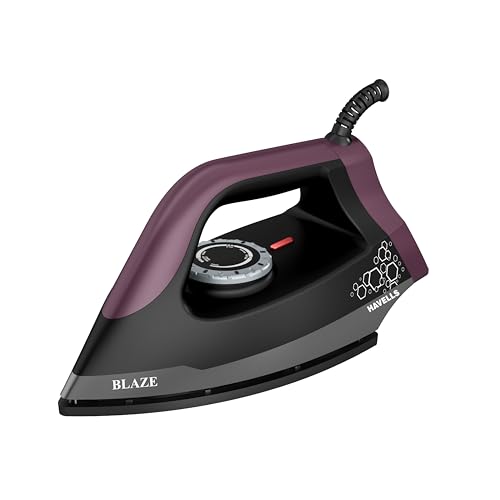
Havells Blaze 2 KG Heavy Weight Dry Iron | 1250W | American Heritage Non-stick Soleplate
The best-balanced 2kg heavy iron — most power, a real safety cut-off, and the lowest price.
- Weight
- 2 kg
- Wattage
- 1250 W (highest here)
- Soleplate
- American Heritage non-stick (ceramic-coated)
- Safety
- Auto-shutoff + even-heat thermostat
- Cord
- 360° swivel
- Warranty
- 2 Years
A genuine 2kg heavy iron with the highest wattage and a rare auto-shutoff, at the lowest price in the field. Just mind the small heel — it can topple if you stand it upright.
- + Highest wattage in the field (1250W)
- + Genuine 2kg mass presses stubborn creases with little effort
- + Auto-shutoff safety (rare on heavy dry irons)
- + American Heritage ceramic non-stick soleplate
- + Cheapest true-2kg option here
- + 5,000+ ratings
- + 360° swivel cord and cool-touch handle
- - Small heel/base tends to topple when stood upright
- - Runs very hot — use lower settings on synthetics
- - Occasional damaged-on-arrival units reported
- - No water-spray or steam (pure dry iron)
Bajaj Herculo Heavy Weight Dry Iron | 1100W | Duraglide Anti-Bacterial Non-Stick Soleplate
The best-rated heavy iron here — Bajaj reliability with a weight that does the work for you.
- Weight
- 1.7 kg
- Wattage
- 1100 W
- Soleplate
- Duraglide aluminium, 2-layer non-stick
- Safety
- Double ISI marking
- Cord
- 360° swivel + organizer
- Warranty
- 2 Years
The highest-rated iron in this roundup and the durability benchmark. At 1.7kg it sits just below the 2kg class, but it presses tough creases effortlessly and is built to last.
- + Highest customer rating in the field (4.3★)
- + Verified daily use reported for 2+ years
- + Weight does the pressing — no force needed
- + Double ISI marking for safety
- + Anti-bacterial 2-layer German non-stick coating
- + Cool-touch body and cord organizer
- - 1.7 kg — just under the 2kg heavy-class threshold
- - A few buyers find it too heavy for quick touch-ups
- - One reviewer flagged a cord-rating spec discrepancy
- - After-sales service experience is inconsistent
Rico 1000W 2KG Heavy Weight Dry Iron AI13 | Japanese Quick-Heat | 3-Layer Non-stick
The proven workhorse — India's most-reviewed 2kg dry iron at a value price.
- Weight
- 2 kg
- Wattage
- 1000 W
- Soleplate
- 3-layer golden American Heritage non-stick
- Safety
- Overheat cut-off + shock-proof
- Warranty
- 2 Years (replacement)
- Ratings
- 9,591 (most-reviewed)
The most battle-tested 2kg iron on Amazon.in with nearly 10,000 ratings. Great value and presses well, though a minority report early failures and a fiddly replacement process.
- + By far the most-reviewed heavy iron in India (9,500+ ratings)
- + Genuine 2kg mass with a broad base
- + Japanese quick-heat element
- + 3-layer golden non-stick soleplate
- + Overheat safety cut-off
- + 2-year replacement warranty
- - Only 1000W — slowest heat-recovery among the 2kg models
- - Recurring reports of units failing within weeks
- - Replacement process can be slow and may cost courier charges
- - No swivel cord or spray
Phynix 3.5 KG Heavy Weight Industrial Dry Iron | Cast-Iron Base | 1000W | Commercial Press
The true commercial press — 3.5kg of cast iron for tailors, laundries and the heaviest fabrics.
- Weight
- 3.5 kg (heaviest)
- Wattage
- 1000 W
- Soleplate
- Thick cast-iron, mirror-finish
- Safety
- Auto-shutoff + calibrated thermostat
- Cord
- 2m cotton-braided copper
- Warranty
- 2 Years
A genuine commercial-grade 3.5kg cast-iron press for tailoring shops and heavy-duty home use. Unbeatable on thick fabric, but heavy by design and still thin on review history.
- + Genuine 3.5kg cast-iron commercial press
- + One-pass wrinkle removal with almost no manual pressure
- + Built for continuous 8-10 hour daily shop use
- + Mirror-finish stainless plate is gentle on fabric
- + Auto-shutoff plus ceramic element and calibrated thermostat
- + 2m braided copper cord and 2-year warranty
- - Only 1 verified India review — long-term reliability not yet proven at scale
- - Very heavy (3.5kg) — requires arm strength and unsuitable for casual use
- - Priciest in the field
- - 1000W is modest for the mass — relies on cast iron retaining heat
Bajaj DX 16 Heavy Weight Dry Iron | 1100W | Duraglide Soleplate | Cool Touch Handle
The most manageable of the bunch — Bajaj reliability in a lighter, easy-to-handle body.
- Weight
- 1.52 kg (lightest)
- Wattage
- 1100 W
- Soleplate
- Duraglide non-stick coated aluminium
- Safety
- Thermal cut-off + cool-touch handle
- Cord
- 360° swivel + organizer
- Warranty
- 2 Years
The easiest iron here to maneuver and the most consistently reviewed, but at 1.52kg it is really a mid-weight — choose it for comfort, not for the maximum self-pressing of a true heavy iron.
- + Lightest in this roundup (1.52kg) — easiest to handle
- + Fast heating with consistently positive recent reviews
- + Bajaj Duraglide non-stick soleplate
- + Cool-touch handle and 360° swivel cord
- + No recurring durability complaints
- + Trusted Bajaj after-sales network
- - 1.52 kg — well below heavy-class
- - less self-pressing on thick fabric
- - You'll apply more manual pressure on jeans and linen
- - No spray or steam
- - Modest review base (252)
Rico 1200W 2KG Heavy Weight Dry Iron AI14 | Japanese Quick-Heat | 3-Layer Non-stick
The higher-wattage Rico 2kg — more power, but less proven than its cheaper sibling.
- Weight
- 2 kg
- Wattage
- 1200 W
- Soleplate
- 3-layer golden American Heritage non-stick
- Safety
- Overheat cut-off + shock-proof
- Cord
- 360° swivel (1.65m)
- Warranty
- 2 Years (replacement)
A 1200W take on Rico's proven 2kg design. The extra wattage helps, but reliability reports trail the cheaper, far more reviewed AI13 — most buyers are better served by that one.
- + 200W more than the AI13 sibling (1200W) for faster heat recovery
- + Genuine 2kg mass with good temperature control
- + 3-layer golden non-stick soleplate
- + Japanese quick-heat element
- + Overheat safety cut-off
- + 2-year replacement warranty with visible MRP discount
- - More early-failure reports than the 1000W AI13
- - Service-centre availability complaints in some cities
- - Lowest rating in the field (4.1★)
- - Near-duplicate of the cheaper
- - better-proven Rico AI13
Usha EI 3710 Primora 2 KG Heavy Weight Dry Iron | 1100W | PTFE Dual-Coated Soleplate
A budget 2kg Usha with a long cord and dual-layer safety — value, with mixed reliability.
- Weight
- 2 kg
- Wattage
- 1100 W
- Soleplate
- PTFE dual-coated non-stick
- Safety
- Overheat protection + dual-layer safety
- Cord
- 1.8m, 360° swivel
- Warranty
- 2 Years
A genuinely 2kg Usha at a sharp price with a long cord and solid safety features, but its rating and a few reliability and thermostat complaints keep it mid-pack.
- + Genuine 2kg body for effortless pressing
- + PTFE dual-coated non-stick soleplate
- + Long 1.8m cord with 360° swivel
- + Overheat protection and dual-layer safety
- + Among the cheapest true-2kg irons here
- + Trusted Usha brand and service network
- - Lowest rating in the field (4.0★) on a small base (136)
- - Several reports of failure within 15 days to 6 months
- - One reviewer reported a scorched garment with weak auto-cut
- - Heavy for users wanting quick touch-ups
Usha Goliath Spray Tech Dry Iron | 1200W | Water Spray | Double-Coated Golden Soleplate
A versatile spray-equipped Usha — handy features, but not a true heavyweight.
- Weight
- ~1.8 kg (marketed)
- Wattage
- 1200 W
- Soleplate
- Double-coated golden Weilberger non-stick
- Special
- Water spray + 5 fabric settings
- Safety
- Thermal fuse cut-off
- Warranty
- 2 Years
A feature-rich Usha with water spray and fabric settings that suits mixed wardrobes, but conflicting weight specs and slow heat-up mean it does not belong with the genuine 2kg+ heavy irons.
- + Water-spray function helps tackle stubborn dry creases
- + 1200W with 5 fabric settings for versatility
- + Double-coated golden Weilberger non-stick soleplate
- + 360° swivel cord and 2-year warranty
- + Solid 4.2★ rating
- + Trusted Usha service network
- - Weight is ambiguous — marketed ~1.8kg but spec table lists 900g
- - Reviewers report it is slow to heat up
- - Small review base (78)
- - The spray makes it a hybrid
- - not a pure heavy dry iron
Final verdict & recommendations
After comparing all eight on pressing power, build, safety and price, here is who each pick is for.
Havells Blaze 2 KG · ₹1,319
Buy this if you want the safest default — most power, a rare auto-shutoff and the lowest price among true-2kg irons.
Check Price on Amazon →Rico 1000W 2KG AI13 · ₹1,535
Buy this if you trust crowd-proven reliability — India's most-reviewed 2kg iron, great on cotton and linen.
Check Price on Amazon →Phynix 3.5 KG Industrial · ₹2,199
Buy this for a tailoring shop or laundry — 3.5kg of cast iron for one-pass pressing on the heaviest fabrics.
Check Price on Amazon →Bajaj DX 16 Heavy Weight · ₹1,479
Buy this for comfort — the lightest, most manageable iron here for long sessions or weaker wrists.
Check Price on Amazon →How to choose the right one
-
Why weight matters more than wattage
On a heavy dry iron, the mass does the pressing — not your arm. A 2kg+ iron flattens thick cotton, denim and heavy sarees in a pass or two with little downward force, which is exactly why tailors and laundries prefer them. Wattage mainly governs how fast the plate heats and recovers; 1000–1250W is ample in this class. If you have weak wrists or only iron light everyday clothes, a true heavyweight may feel tiring — consider a 1.5–1.75kg model instead. -
Soleplate: non-stick vs cast iron vs stainless
Non-stick coated aluminium (American Heritage, Weilberger, PTFE) glides easily and is gentle on synthetics, but the coating can wear over years of heavy use. Cast-iron and mirror-finish stainless plates (as on the Phynix 3.5kg) retain heat superbly and are near-indestructible — ideal for commercial use — but are heavier and need more care on delicate fabrics. For mixed home wardrobes, a coated 2kg plate is the sweet spot. -
Safety features to look for
Auto-shutoff is the single most valuable safety feature and is rare on heavy dry irons — the Havells Blaze and Phynix both have it. Otherwise look for overheat protection / a thermal fuse (cuts power if the thermostat fails) and ISI marking (double ISI on the Bajaj Herculo). Heavy irons run hot and retain heat long after switch-off, so a cut-off and a cool-touch handle genuinely matter. -
Matching the iron to your use
For everyday home pressing of cottons and formals, a 2kg coated iron (Havells Blaze, Rico AI13) is ideal. For a tailoring shop, boutique or laundry running 8–10 hours a day, step up to the 3.5kg cast-iron Phynix built for continuous duty. If most of your load is light synthetics and quick touch-ups, a heavyweight is overkill — a lighter 1.5kg iron will be less tiring. -
Reading the review record honestly
A high rating on thousands of reviews (Rico AI13: 9,500+, Havells: 5,000+) is far more trustworthy than a perfect score on a handful. The most common genuine complaint in this category is early failure followed by a slow or costly replacement process — so factor in the brand's service network. Newer or niche models (the Usha Primora, the Phynix commercial press) can still be excellent, but their long-term reliability is simply less validated. -
Handling and storing a heavy iron
Several heavy irons have small heels and can topple if stood upright — the Havells Blaze is a noted example. Set it down flat on a heat-safe rest between presses, keep the cord clear of the hot plate, and let it cool fully before storing. A 360° swivel cord (most models here) reduces drag and tangling during long sessions.
Frequently asked questions
What is the best dry iron in India?
What is the difference between a 2kg and 3.5kg heavy weight dry iron?
Why do commercial dry irons take 10-15 minutes to heat up while regular irons take 2-3 minutes?
Is 1200W better than 1000W for heavy weight dry irons, or does it just waste electricity?
Do I need a professional heavy weight iron for home use, or is a standard 1kg iron enough?
Do these dry irons have steam or spray?
Are these irons safe to leave plugged in?
Why do some irons fail within weeks?
What is the advantage of anti-bacterial coating on dry iron soleplates?
Will a 2kg iron damage delicate clothes?
Which iron is best for a tailoring shop or laundry?
How long do 3-layer American heritage or German coatings last compared to standard non-stick?
Why does the Phynix 3.5kg industrial iron cost only a little more than a smaller 2kg iron — shouldn't heavier be far more expensive?
Should I buy the Usha Goliath Spray Tech or a separate steam iron for a small tailoring business?

Technologist and product researcher. Every recommendation is backed by aggregating thousands of Amazon reviews, comparing specs across brands and tracking price trends — so you don't have to.
More about how we research →You may also like
More guides and reviews to help you decide.
Best steam irons under ₹1,500 in India 2026. Philips, Usha & Wipro compared on steam output, soleplate, weight and reliability — with real prices, pros & cons.
Read more →Find the best steam iron under 5000 in India 2026. Compare Philips, Hamilton Beach, Black+Decker & Wipro with expert reviews, prices, pros & cons.
Read more →Find the best steam iron under 2500 in India 2026. Compare Philips, Crompton & more with expert reviews, prices, pros & cons. Budget options from ₹1,049.
Read more →Find the best kettlebell in India 2026. Compare Amazon Basics, Lifelong & more with expert reviews, prices & pros and cons.
Read more →Expert iron buying guide for India: Dry iron ₹500-₹800 for basic use, steam iron ₹1000-₹3000 for families, steam generator ₹5000+ for heavy ironing.
Read more →Best room heaters in India 2026 — compare the top fan, convection and halogen heaters from Bajaj, Havells & more with prices, pros and cons.
Read more →