
PRODUCT REVIEW
Best High Pressure Washers in India 2026
We analysed owner reviews of 10 car pressure washers. The IBELL YO1800 wins on reliability at ₹4,599 — induction motor, bucket-draw, 1-year warranty.
 By Naveen Bhavnani
Updated
By Naveen Bhavnani
Updated
As an Amazon Associate we earn from qualifying purchases. We could also earn a fee through some links when you click on them.

Pressure washer picks by motor
Already covered the winner above — here are the picks for specific needs.

Shakti Technology S5 High Pressure Car Washer

IBELL Microjet High Pressure Washer
Pressure washers compared on bar
How the shortlist stacks up. Scroll sideways on mobile.
| WWCD Score | Product | Motor | Pressure | Recent 1-2★ | Price | Deal |
|---|---|---|---|---|---|---|
| 8.0/10 | IBELL YO1800 | Induction | 120 bar | 11% (best) | ₹4,599 | Check Price |
| 7.7/10 | Shakti Technology S5 | Universal | 125 bar | 25% | ₹6,774 | Check Price |
| 7.7/10 | IBELL Microjet | Induction | 120 bar | 14% | ₹10,990 | Check Price |
| 7.2/10 | IBELL WIND55 | Universal | 130 bar | 27% | ₹8,390 | Check Price |
| 7.1/10 | GoMechanic | Universal | 140 bar max | 28% | ₹4,699 | Check Price |
| 7.0/10 | Shakti Technology S3 | Universal | 120 bar | 26% | ₹4,680 | Check Price |
| 7.0/10 | AGARO Supreme | Universal | 120 bar | 31% | ₹5,399 | Check Price |
| 6.9/10 | Bosch Universal Aquatak 125 | Universal | 125 bar | 45% | ₹10,799 | Check Price |
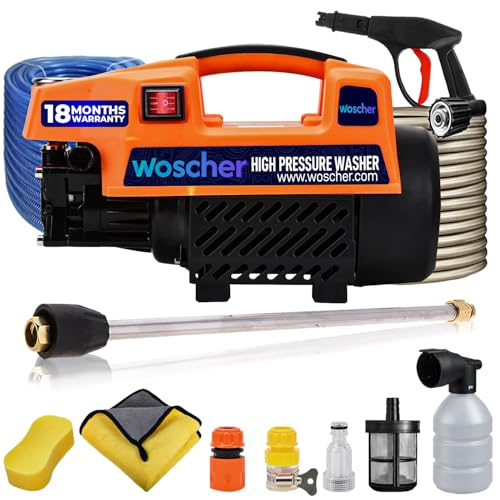
| 6.7/10 | Woscher AquaWash 878 | Universal | 150 bar max | 33% | ₹4,498 | Check Price |
| 6.4/10 | Wintech Pro WT PW6500 | Induction (claimed) | 130 bar | Unproven (n=9) | ₹4,599 | Check Price |



In this category, reliability beats the badge
High-pressure washers fail early and often. In the verified India reviews we analysed, the share rating a unit 1-2 stars in the last 100 reviews ran from 11% on the induction IBELL YO1800 up to 45% on the Bosch Universal Aquatak 125. Brand prestige did not protect buyers: all three Bosch models we checked sat at 45-49% recent-negative.
The pattern is clear — confirmed induction motors last, universal motors run hot and burn out, and the trigger gun and foam bottle usually fail before the pump does. Whatever you buy, run it at full pressure in the first two weeks so you can return a bad unit while you still can.
Induction vs universal motors — the real durability divide
The motor is the single biggest thing that decides how long a car washer survives — more than pressure, brand or price. There are two kinds, and the verified reviews we analysed split hard along that line.
Induction motors last, and run quiet. They cost a little more, but they are the ones owners keep.
- No brushes to wear out. The motor runs cool and near-silent, so it shrugs off back-to-back car washes.
- It outlasts the cheaper type by years. Under repeated wash-day use an induction motor simply keeps going.
- Our data backs it up. The induction IBELL YO1800 drew just 11% recent 1-2 star reviews, and the Microjet 14% — the two lowest here.
- The catch: the label lies. "Induction" is claimed falsely all the time, so trust reviews that mention quiet running, not the box.
Universal (brushed) motors are cheaper, but they burn out. They are lighter and louder, and they run hot.
- It needs to rest. Most want a 15-20 minute break each session, or the motor overheats and fails early.
- The brushes cook the windings. The same parts that make it cheap wear down and run hotter over time.
- Our data backs it up. Universal units here ran 25-45% recent 1-2 star — up to four times the induction failure rate.
- The tell-tale. A listing that tells you to rest the motor or change its oil is admitting it runs hot.
Pressure washer reviews — motor, bar and complaints
Specs, the honest pros and cons, and who each one is for.
IBELL YO1800 High Pressure Washer
The induction motor that actually lasts — the value car-wash pick to beat.
- Motor
- Induction (stated)
- Pressure
- 120 bar
- Flow rate
- 390 L/hr
- Hose length
- 8 m
- Self-priming
- Yes (bucket filter)
- Warranty
- 1 year
- Weight
- 4 kg
The clear best-overall: a real induction motor, the lowest recent failure rate in a category full of them, bucket-draw convenience and a 1-year warranty, all at ₹4,599. Not the highest pressure or the fanciest foam, but the one most likely to still be working next year.
- + Genuine induction motor — quiet and long-lived
- + Best recent reliability here (only 11% negative)
- + Draws water straight from a bucket
- + Light and portable at ~4kg
- + 1-year warranty
- + Lowest induction price at ₹4,599
- - 120 bar is mid-pack pressure
- - Basic clip-on soap bottle (no foam cannon)
- - A few DOA/damaged-in-transit reports
- - Plastic body needs gentle handling
Shakti Technology S5 High Pressure Car Washer
The most-equipped car-wash rig — real foam cannon, high flow, longest hose.
- Motor
- Universal (Venturi)
- Pressure
- 125 bar
- Flow rate
- 480 L/hr
- Hose length
- 10 m
- Self-priming
- Yes (self-intake)
- Warranty
- 1 year
- Weight
- 13 kg
The best-seller-tier all-rounder and the pick for people who want the full car-wash kit out of the box — a genuine foam cannon, 480 L/hr flow and a 10m hose. Reliability is the best of the mainstream high-volume units (25% recent negative), but it is a universal motor in a heavy 13kg body, and a minority report overheating or cheap fittings.
- + Ships a real snow-foam cannon (not a snap-on bottle)
- + Highest flow (480 L/hr) and longest hose (10m)
- + Best-selling reliable option (7395 ratings at 4.4)
- + Self-intake from a bucket plus pressure gauge
- + 1-year warranty
- - Universal motor — runs hotter than induction
- - Some report motor overheating or stopping
- - Complaints of aluminium (not brass) internal threads
- - Heavy at 13kg — least portable here
IBELL Microjet High Pressure Washer
The quiet, well-built induction premium — if you can find the spares.
- Motor
- Induction (stated)
- Pressure
- 120 bar
- Flow rate
- 450 L/hr
- Hose length
- 5 m
- Self-priming
- Yes
- Warranty
- 1 year
- Weight
- 5 kg
A genuinely good induction machine with the best build feel of the induction group and solid recent reliability, but it asks ₹10,990 for specs the YO1800 delivers at less than half the price, ships a short 5m hose, and has a thin review base with spare-part scarcity. A considered premium buy, not a value one.
- + Induction motor with the best build feel here
- + Good recent reliability (14% negative)
- + 450 L/hr flow with a turbo nozzle
- + Bucket-draw self-priming
- + Compact 5kg body
- - Expensive at ₹10,990 for 120 bar
- - Short 5m hose limits reach around a car
- - Gun reportedly fails at ~3 months with no spare
- - Thin 169-rating base and slow sales
IBELL WIND55 High Pressure Washer
High output, but out-muscled on value by IBELL's own induction YO1800.
- Motor
- Universal
- Pressure
- 130 bar
- Flow rate
- 468 L/hr
- Hose length
- 5 m
- Self-priming
- Yes (bucket filter)
- Warranty
- 1 year
- Weight
- 6 kg
A capable high-output IBELL with 130 bar and 468 L/hr, but it is a universal-motor unit at ₹8,390 — and IBELL's own YO1800 gives you an induction motor and better reliability for far less. Kept for its output and established base, but the short hose, spare-part scarcity and 27% recent-negative rate hold it back.
- + High cleaning output — 130 bar and 468 L/hr
- + Turbo nozzle for stubborn grime
- + Bucket-draw self-priming
- + Established IBELL model with 1204 ratings
- - Universal motor despite the price
- - 27% of recent verified reviews are 1-2 star
- - Owners report no service centres for spares
- - Short 5m hose and pricey at ₹8,390
GoMechanic Car Washer High Pressure Machine
Familiar auto brand and a big accessory kit — let down by warranty support.
- Motor
- Universal (inferred)
- Pressure
- 140 bar max (~110-120 working)
- Flow rate
- 450 L/hr
- Hose length
- 8 m
- Self-priming
- Yes (bucket filter)
- Warranty
- 1 year
- Weight
- 8.25 kg
A recognisable-brand budget option with a strong on-paper spec and a generous accessory kit, but recent verified buyers report motors overheating within a couple of months and — the recurring theme — GoMechanic not honouring warranty support. Fine value if it works; a headache if it doesn't.
- + Recognisable Indian auto brand at ₹4,699
- + Strong output on paper (450 L/hr)
- + Generous 8m hose plus extension rod
- + Complete car-wash accessory kit
- - Motor overheating/burnout within ~2 months reported
- - GoMechanic warranty support hard to get
- - Motor type not disclosed (2200W implies brushed)
- - 140 bar is a headline not working figure
Shakti Technology S3 High Pressure Car Washer
The popular Shakti best-seller — capable and cheap, but only 6 months' cover.
- Motor
- Universal (copper)
- Pressure
- 120 bar
- Flow rate
- 360 L/hr
- Hose length
- 8 m
- Self-priming
- Yes (self-intake)
- Warranty
- 6 months
- Weight
- 9.98 kg
One of the category's best-sellers and a low-cost way into a capable 120-bar car washer, with bucket-draw and an 8m hose. The catches are a short 6-month warranty and a 26% recent-negative rate driven by DOA units — plus an isolated but worth-noting report of body current leakage. Good value if you get a good unit; test it early within the return window.
- + Among India's best-selling car washers (6478 ratings)
- + Low ₹4,680 price for a capable 120-bar unit
- + Self-intake from a bucket plus 8m hose
- + Auto-stop and adjustable fan lance
- - Only a 6-month warranty — shortest here
- - 26% of recent reviews are 1-2 star (DOA units)
- - One report of body current leakage — check earthing
- - Universal motor in a heavy 10kg body
AGARO Supreme High Pressure Washer
The most-reviewed name in the category — but its recent record has slipped.
- Motor
- Universal (inferred)
- Pressure
- 120 bar
- Flow rate
- 390 L/hr
- Hose length
- 8 m
- Self-priming
- Yes (bucket filter)
- Warranty
- 1 year
- Weight
- 9.05 kg
AGARO has the biggest review base and a 1-year warranty, but it also carries the lowest rating (3.9) and the worst recent reliability of the Indian-brand units — 31% of recent verified buyers are unhappy, citing weak pressure, motors dying within months and poor support. Listed for its scale and brand recognition, but out-performed on recent reliability by the IBELL and Shakti picks above it.
- + Most-reviewed car washer here (10084 ratings)
- + 1-year warranty
- + 8m hose with bucket-draw and extension rod
- + Established AGARO India service presence
- - Lowest headline rating here at 3.9 stars
- - 31% of recent reviews are 1-2 star
- - Complaints of weak real-world pressure
- - Poor after-sales support cited by many
Bosch Universal Aquatak 125 High Pressure Washer
The famous Bosch name — but its recent Indian reliability has collapsed.
- Motor
- Universal
- Pressure
- 125 bar
- Flow rate
- 360 L/hr
- Hose length
- 5 m
- Self-priming
- Yes
- Warranty
- 6 months
- Weight
- 6 kg
The best-known name in the category and genuinely the best nozzle system, but the recent verified record is alarming: 45% of the last 100 Indian buyers rate it 1-2 star, with motors failing inside the 6-month warranty and service hard to reach. Kept in the list because it is the Bosch buyers search for — but on this evidence it is hard to recommend over the induction picks above it. If you buy it, test it hard in the first weeks.
- + Genuine 3-in-1 nozzle (fan/rotary/pencil)
- + Compact 6kg with wheels and telescopic handle
- + Self-priming from an external source
- + Huge brand recognition (9160 ratings)
- - Reliability failure — 45% of recent reviews are 1-2 star
- - Motors burn out or smell within 3-6 months
- - Only a 6-month warranty at ₹10,799
- - India service hard to reach and short 5m hose
Woscher AquaWash 878 High Pressure Car Washer
Cheapest of the lot, but the shakiest warranty and gun-quality record.
- Motor
- Universal (inferred)
- Pressure
- 150 bar max (~110-120 working)
- Flow rate
- 480 L/hr
- Hose length
- 8 m
- Self-priming
- Not stated
- Warranty
- 1 yr (+6mo disputed)
- Weight
- 9.5 kg
The lowest price here buys high flow and an 8m hose, but Woscher has the weakest recent reliability of the Indian-brand picks (33% negative): guns that leak within months, units dying just past warranty, and an "18-month" cover that buyers say is denied. A gamble that only makes sense if the small saving over the YO1800 matters more than reliability.
- + Cheapest unit in the selection at ₹4,498
- + High flow (480 L/hr) and a full 8m hose
- + Decent value-for-money verdicts from many buyers
- - 33% of recent reviews are 1-2 star
- - Gun leaks within ~7 months
- - Gun won't fit standard aftermarket foam cannons
- - Advertised 18-month warranty reported as denied
Wintech Pro WT PW6500 High Pressure Washer
A 2-year warranty on paper — but almost no track record to back it.
- Motor
- Induction (claimed
- Pressure
- 130 bar
- Flow rate
- 400 L/hr
- Hose length
- 8 m
- Self-priming
- Not stated
- Warranty
- 2 years
- Weight
- 6 kg
Interesting on paper — a claimed induction motor and a 2-year warranty at ₹4,599 — but with just 9 ratings and an unknown importer, there is no evidence it lasts, and the induction claim is unverified. Listed for completeness and its warranty, but buy only if you are willing to be an early adopter; the IBELL YO1800 is the proven pick at the same price.
- + Longest advertised warranty here (2 years)
- + Claims an induction motor at ₹4,599
- + 8m hose and a full accessory kit on paper
- - Only 9 lifetime ratings — reliability UNPROVEN
- - No-name importer with no service track record
- - Early reviews flag torn packaging and missing parts
- - Induction claim unverified
Which pressure washer to buy
Every pick here earns its place on recent verified-owner reliability, not headline pressure. If you'd rather skip the full comparison, these are the two worth choosing between.
For most people, buy the IBELL YO1800 (₹4,599). It's the only budget unit here with a genuine induction motor, and the most reliable in our review data — just 11% of its last 100 verified reviews rated it 1-2 stars. It draws water straight from a bucket and undercuts every other induction unit on price. Get it unless you want a proper foam wash out of the box.
Check Price on Amazon →Want a full foam wash out of the box? Get the Shakti Technology S5 (₹6,774) — the only unit here that ships a genuine snow-foam cannon, with the highest flow (480 L/hr) and the longest 10m hose for reaching around a car. The trade-off is a universal motor and a heavy 13kg body.
Check Price on Amazon →How to choose a pressure washer
-
How much pressure a car actually needs (bar vs PSI)
For car washing, 100–130 bar is the sweet spot. It clears mud and road grime without lifting paint, stripping wax or forcing water past door and window seals.
- Bar and PSI measure the same thing. One bar is about 14.5 psi, so a 120-bar washer is roughly 1,740 psi.
- Higher is not better here. Above 140 bar you risk paint damage for no real cleaning gain on a car.
- Start low. Raise the pressure only where grime is stubborn.
-
Pick the motor, not the pressure number
The motor decides how long your washer lasts — not the headline pressure number. A real induction unit at 120 bar beats a universal one claiming 150-plus.
- Universal (brushed) motors run hot. Cheap, but they need a rest every 15–20 minutes.
- Induction motors last longer. Cooler, quieter, and good for far more use.
- Ignore inflated "max pressure". Cleaners are rated 25 to 350 bar under the international safety standard, but 350 bar is industrial-tier.
- A home unit tops out near 120–130 bar. So "350 bar" on a sub-₹7,000 box is fiction.
-
Insist on self-priming (bucket draw)
Unless you have a pressurised garden tap, buy a washer that can self-prime from a bucket or tank. Otherwise it may not run at all in an apartment or basement parking.
- Look for bucket draw. It pulls water through an inlet hose and filter, so no tap pressure is needed.
- Most Indian-brand units here support it. Some imported models need an extra suction kit.
Check the spec before you buy — a unit that cannot self-prime is useless in a flat.
-
Foam cannon vs foam bottle
Most washers ship a snap-on foam bottle that dribbles weak suds. A true snow-foam cannon — like the one bundled with the Shakti S5 — uses a venturi to make thick, clinging foam instead.
- Thick foam is gentler. It lifts grit before you touch the paint, protecting the clearcoat from wash scratches.
- Check the gun fitting. A standard fitting lets you add an aftermarket cannon later; the Woscher's does not.
-
Which nozzle is safe on car paint
Use a wide fan spray held about 30 cm away, never a pinpoint jet up close. On car paint a concentrated stream cuts straight through the clearcoat.
- Skip the zero-degree needle nozzle. It can injure you and damage surfaces.
- Turbo nozzle is for wheels and undercarriage. Keep it off bodywork.
- Keep the trigger moving. Never dwell on one spot.
-
Read the warranty length — and whether spares exist
Warranties here run from 6 months (Shakti S3 and all Bosch models) to 2 years (Wintech). But length matters less than whether service and spares actually exist.
- The trigger gun and foam bottle fail first. These consumables wear out across every brand.
- Many units sell no spare parts. A ₹200 component you cannot replace can kill the whole machine.
Favour brands with a real India service presence and available consumables.
-
Test hard inside the return window
The dominant failure here is early — dead-on-arrival units and motors that burn out in the first few months. Test hard while you can still return it.
- Run it at full pressure in the first two weeks. Do a proper car wash, not a quick trial.
- Watch for warning signs. Check for oil leaks, and listen for a motor smell or overheating.
- Always use a properly earthed socket. These are high-wattage units used near water.
-
Match hose length and weight to your space
Two things decide how annoying a washer is to use day to day: hose length and weight. Match both to your parking and storage.
- An 8–10 m hose lets you circle a car. A 3–5 m hose (Bosch Aquatak 125, IBELL Microjet and WIND55) means constant repositioning.
- Heavier units feel solid but tire you out. The 13 kg Shakti S5 is a chore upstairs; 4–5 kg induction units store and move easily.
-
Electric vs petrol pressure washers
For home car washing, an electric washer is the clear choice. It delivers the 110–150 bar that cars and bikes want, with almost none of petrol's cost or upkeep.
- Electric costs ₹4,000–₹25,000. It runs quietly enough for a residential street and needs almost no maintenance.
- Petrol costs ₹50,000-plus. It runs at 200 bar and above and needs fuel, oil changes and spark plugs.
Pick petrol only for a commercial car-wash or industrial cleaning without mains power.
-
Maintenance tips for longevity
A little care doubles a washer's life. The habits below take barely a minute each.
- Flush after every wash. Run clean water through for a minute or two to clear soap and grit.
- Clean the inlet filter every few uses. Check the hose and connectors monthly for cracks.
- Rest a universal-motor unit. Give it 10–15 minutes off after 20–30 minutes of use.
- Change the pump oil. Follow the interval your manual states.
Frequently asked questions
What Bar or PSI is best for car washing in India?
Can I use a high pressure washer on my bike safely?
What is the difference between Bar and PSI pressure ratings?
How much water does a pressure washer use compared to a garden hose?
Do I need a foam gun for car washing, or can I skip it?
How should I maintain my pressure washer to make it last longer?
Electric vs petrol pressure washer — which is better for home car washing?
What accessories are essential for car washing with a pressure washer?
Are the "350 bar" or "240 bar" washers really more powerful?
Induction motor vs universal motor — does it matter?
Can these washers run from a bucket, or do I need a tap connection?
Why is the Bosch scored so low if it's a trusted brand?
Which one should most people buy?
Sources & References
- IEC 60335-2-79:2021 — Safety of High Pressure Cleaners and Steam Cleaners International Electrotechnical Commission · 2021 Defines the high-pressure-cleaner class as rated pressures of 2.5-35 MPa (25-350 bar), placing 350 bar at the industrial ceiling of the standard — far above any single-phase home car washer.
- Bar (unit of pressure) Wikipedia Source for the conversion used throughout: 1 bar = 100 kPa ≈ 14.5 psi, so a 120-bar washer is about 1,740 psi.
- Pressure washing — operating pressures and nozzle safety Wikipedia Documents that a zero-degree needle nozzle can injure the user and damage surfaces, supporting the wide-fan, keep-distance guidance for car paint.
You may also like
More guides and reviews to help you decide.
Find the best wet dry vacuum cleaner in India 2026. Compare AGARO & more with research-based reviews, prices & pros and cons.
Read more →Find the best cordless vacuum India offers in 2026. AGARO, Dreame, Eureka Forbes compared for suction power, battery life & pet hair cleaning. In-depth reviews.
Read more →Comprehensive vacuum cleaner buying guide covering upright, canister, stick, handheld, and robotic models. Power ratings, filtration systems, and budget.
Read more →9 best car vacuum cleaners in India 2026 compared. SEZNIK Mustang wins (15kPa, 4.4★). Cordless, corded, hybrid models from ₹1,099 to ₹3,499.
Read more →Best cordless tyre inflators in India for 2026 - battery-powered and compact wireless picks compared (Portronics Vayu 2.0, Xiaomi 240g, AGARO Regency).
Read more →Best 12V wired tyre inflators in India for 2026 - corded car-socket inflators with unlimited runtime, plus heavy-duty picks for SUVs, jeeps and 4x4s.
Read more →