
PRODUCT REVIEW
Best Immersion Water Heater in India 2026
Compare the 10 best immersion water heaters in India for 2026 — Crompton, Hindware, GM, Havells & Bajaj rods from ₹455 to ₹2,459.
 By Naveen Bhavnani
Updated
By Naveen Bhavnani
Updated
As an Amazon Associate we earn from qualifying purchases. We could also earn a fee through some links when you click on them.
Immersion rod picks by wattage
Already covered the winner above — here are the picks for specific needs.

Hindware Atlantic Kweik 1.5kW Portable Water Heater

Havells HP15 Auto 1500W Immersion Heater

GM Hot Pro 1000W Immersion Rod with Bucket Guard
Immersion rods compared on safety
How the shortlist stacks up. Scroll sideways on mobile.
| WWCD Score | Product | Wattage | Element | Safety | Cord | Weight | Warranty | Price | Deal |
|---|---|---|---|---|---|---|---|---|---|
| 9.1/10 | Crompton 1500W | 1500W | Copper + Nickel | IP68 Waterproof | Standard | 530g | 2 Years | ₹699 | Check Price |
| 9.1/10 | DigiSmart 2000W | 2000W | Stainless Steel | Double ISI | Standard | 700g | 1 Year | ₹528 | Check Price |
| 9.0/10 | Hindware Kweik | 1500W | Shielded Element | IPX7 + Thermostat | Standard | 1100g | 2 Years | ₹2,459 | Check Price |
| 8.9/10 | GM 1500W | 1500W | Copper + Nickel | Double ISI + Guard | 1.6m | 470g | 2 Years | ₹649 | Check Price |
| 8.8/10 | Better Home Fumato | 1500W | Copper | ISI | 1.5m | 500g | Replacement | ₹649 | Check Price |
| 8.8/10 | Orient Arc Plus | 1500W | Copper | IPX7 | Standard | 520g | 2 Years | ₹549 | Check Price |
| 8.8/10 | Havells Zeta | 1500W | Nickel-plated | ISI + Indicators | Standard | 590g | 2 Years Comp. | ₹599 | Check Price |
| 8.7/10 | GM 1000W | 1000W | Copper + Nickel | Double ISI + Guard | 1.6m | 420g | 2 Years | ₹455 | Check Price |
| 8.7/10 | Havells HP15 Auto | 1500W | Nickel-plated | ISI + Auto-Cutoff | Standard | 670g | 2 Years | ₹921 | Check Price |
| 8.4/10 | Bajaj 1500W | 1500W | Copper + Nickel | ISI | Short | 540g | 2 Years | ₹649 | Check Price |


Electrical safety comes first
Immersion rods combine electricity and water, so safety is non-negotiable. Only buy an ISI-certified rod, always fully submerge the element before switching it on, and never touch the water or remove the rod while it is plugged in.
Avoid using extension boards near water, use an earthed 3-pin socket, and replace any rod immediately if you notice cracks, discoloration or sparking near the plug. These habits prevent the vast majority of immersion-rod accidents.
Immersion water heater reviews: wattage, element and ISI
Specs, the honest pros and cons, and who each one is for.
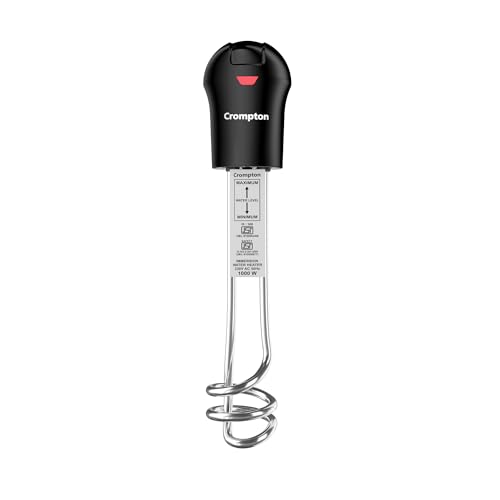
Crompton AIMR-SP15A 1500W Immersion Rod
The safest and most reliable 1500W immersion rod you can buy today
- Wattage
- 1500 Watts
- Element
- Copper with Nickel Plating
- Waterproof Rating
- IP68
- Length
- 34 cm
- Weight
- 530 g
- ISI Certified
- Yes
- Warranty
- 2 Years
Crompton's IP68-rated immersion rod sets the standard for safety in a category plagued by durability and shock complaints. Its near-zero complaint rate and copper construction make it the clear top pick for anyone who values reliability.
- + IP68 certified waterproof — highest water protection in the category
- + 100% shock-proof body with ABS handle
- + Copper heating element with anti-corrosive nickel plating
- + Water level indicator prevents dry heating
- + Exceptionally low complaint rate — only 2 critical reviews out of 109
- - Newer product with only 109 ratings — long-term reliability less validated
- - One reviewer reported the plug may not fit all socket types
- - No auto-cutoff or temperature control
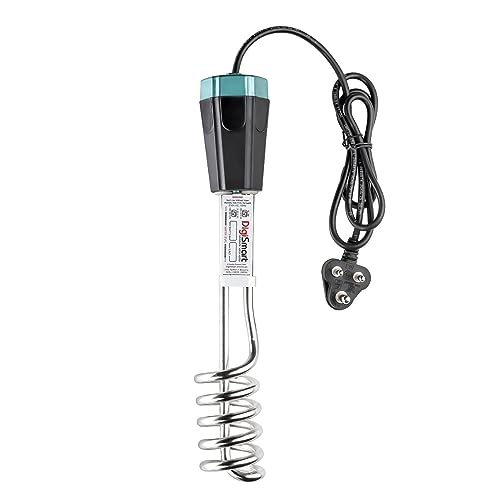
DigiSmart 2000W Immersion Water Heater Rod
The fastest-heating immersion rod at an unbeatable price
- Wattage
- 2000 Watts
- Element
- Stainless Steel
- Weight
- 700 g
- ISI Certified
- Double ISI
- Warranty
- 1 Year
- Voltage
- 230V
If speed is your priority, nothing in this category comes close to the DigiSmart's 2000W output at just ₹528. The only trade-off is a shorter 1-year warranty, but double ISI certification provides confidence in safety.
- + 2000W — fastest heating in the category and 33% more powerful than 1500W rods
- + Double ISI certified for both safety and performance
- + Stainless steel construction resists rust and corrosion
- + Incredibly affordable at ₹528 for 2000W — best value in the field
- + Over 1188 ratings validate real-world reliability
- - Only 1-year warranty — shortest in the comparison
- - 2000W draws more power and needs a 16A socket
- - Lesser-known brand than Bajaj/Havells/Crompton
- - Heavier at 700g due to the higher-wattage element
Hindware Atlantic Kweik 1.5kW Portable Water Heater
The premium hands-free immersion heater with unmatched safety
- Wattage
- 1500 Watts
- Element
- Plastic body with shielded element
- Max Temperature
- 72°C
- Weight
- 1100 g
- Waterproof
- IPX7
- Mount Type
- Standalone / Wall Mount
- Warranty
- 2 Years
A completely different class of immersion heater — standalone, thermostat-controlled, and loaded with safety features no rod can match. Worth the premium if safety and convenience are non-negotiable.
- + Standalone design — stands on its own in the bucket with no need to hold or clip
- + Most comprehensive safety: IPX7 + thermostat + overheat + dry-heat protection
- + Power and heating indicators eliminate guesswork
- + Shield design heats water uniformly without manual stirring
- + Wall-mountable for neat storage
- + 2-year warranty from Hindware
- - At ₹2,459 it costs 4-5x more than standard immersion rods
- - Thermostat caps at 72°C — water won't reach boiling temperature
- - Heaviest at 1100g — less portable than traditional rods
- - Standalone design only fits standard round buckets
GM Hot Pro 1500W Immersion Rod with Bucket Guard
The innovative bucket-guard immersion rod with double ISI safety
- Wattage
- 1500 Watts
- Element
- Copper with Nickel Plating
- Cord Length
- 1.6 m
- Weight
- 470 g
- Plug
- 16 AMP
- ISI Certified
- Double ISI
- Warranty
- 2 Years
GM's bucket guard is a genuinely useful innovation that no other brand offers — it prevents the hot element from touching the bucket or your hands. Combined with the longest cord and double ISI, it's a smart pick for households with children.
- + India's first immersion rod with a bucket guard — prevents accidental contact with the hot element
- + Double ISI certified for safety and performance
- + Longest cord at 1.6m — reaches any socket comfortably
- + Loop hanger for safe post-use storage
- + Copper element with nickel plating for corrosion resistance
- + 16A plug for safer high-power operation
- - Bucket guard may heat the bucket plastic in some cases per reviews
- - Some users report warranty service challenges with GM
- - No water level indicator or heating indicator light
- - Bucket guard adds bulk and won't fit narrow containers
The Better Home Fumato 1500W Immersion Rod
The highest-rated 1500W copper rod in this comparison
- Wattage
- 1500 Watts
- Element
- Copper element
- Length
- 40 cm
- Cord Length
- 1.5 m
- Weight
- 500 g
- ISI Certified
- Yes
- Warranty
- Replacement policy
The highest-rated product in this comparison at 4.4 stars, with a full copper element and the longest 40cm rod body, at ₹649. A solid mid-price pick, though the low review count means long-term reliability is still being proven.
- + Highest rating in the comparison at 4.4 stars
- + Full copper element at ₹649 — mid-pack price for a 1500W copper rod
- + 1.5m cord — longer than most branded competitors
- + Longest rod body at 40cm — more heating surface area
- + Lightweight and portable — ideal for hostels and travel
- - Only 45 ratings — long-term reliability unproven
- - Lesser-known brand with a limited after-sales network
- - No indicator light or water level marking
- - Warranty details unclear (replacement policy only)
Orient Electric Arc Plus 1.5kW Immersion Water Heater
Feature-rich 1500W rod with IPX7 protection at a competitive price
- Wattage
- 1500 Watts
- Element
- Copper (spiral design)
- Length
- 36 cm
- Weight
- 520 g
- Waterproof
- IPX7
- ISI Certified
- Yes
- Warranty
- 2 Years Replacement
Strong on paper with IPX7 protection and spiral copper design at just ₹549, but recent reviews reveal concerning durability issues. Orient's warranty service needs significant improvement.
- + IPX7 waterproof and 100% shock-proof body
- + Spiral copper element design for uniform heating
- + #2 bestseller in Immersion Rods with 2898 ratings
- + Bucket clip ensures correct immersion depth
- + Ergonomic handle and moulded plug design
- + 2-year replacement warranty
- - Multiple recent reviews report cracks developing in 4-6 months
- - After-sales warranty service frequently criticized as slow or unresponsive
- - Some users report element holes during heating
- - No indicator light or temperature control
Havells Zeta 1500W Immersion Heater
Havells trust with indicator lights for worry-free operation
- Wattage
- 1500 Watts
- Element
- Nickel-plated element
- Length
- 34 cm
- Weight
- 590 g
- ISI Certified
- Yes
- Warranty
- 2 Years Comprehensive
The Havells brand name and indicator lights make the Zeta a reliable mid-range pick. The 2-year comprehensive warranty provides peace of mind, though the short cord and occasional early failures are drawbacks.
- + Built-in heating indicator light — know at a glance when it's operating
- + Water level indicator prevents unsafe dry usage
- + Touch protection cover for added safety
- + Havells brand trust with a 2-year comprehensive warranty
- + #1 bestseller rank in Immersion Rods
- + 4.3-star rating — second highest in the comparison
- - Short power cord — multiple reviewers wish it were longer
- - Some reports of stopping within 2-3 months of use
- - Warranty service can be slow and requires visiting service centers
- - 16A plug may not fit all home sockets without an adapter
- - Plastic body (not copper) for the element housing
GM Hot Pro 1000W Immersion Rod with Bucket Guard
The most affordable immersion rod with bucket guard safety
- Wattage
- 1000 Watts
- Element
- Copper with Nickel Plating
- Cord Length
- 1.6 m
- Weight
- 420 g
- Plug
- 6 AMP
- ISI Certified
- Double ISI
- Warranty
- 2 Years
If you need a 1000W rod that plugs into any standard 6A socket, the GM 1000W is unbeatable at ₹455. The bucket guard adds a safety layer no other budget rod offers. Just expect slower heating than 1500W options.
- + Cheapest product in the comparison at ₹455
- + Bucket guard prevents accidental contact with the hot element
- + 6A plug — fits standard household sockets without any adapter
- + Lightest rod at 420g — very portable
- + Longest cord at 1.6m with a loop hanger for storage
- + Double ISI certified
- - 1000W heats water significantly slower than 1500W options
- - Not ideal for large buckets or quickly heating large volumes
- - Some reviews mention quality control issues
- - No indicator lights
Havells HP15 Auto 1500W Immersion Heater
The only immersion rod with auto-cutoff and temperature control
- Wattage
- 1500 Watts
- Element
- Nickel-plated element
- Length
- 34 cm
- Weight
- 670 g
- Special
- Auto cut-off + Low/Med/High temp control
- ISI Certified
- Yes
- Warranty
- 2 Years
A unique proposition with auto-cutoff and temperature control that no other standard rod offers. However, the auto-cutoff frustrates many users by cutting off before water is hot enough, and the premium price is hard to justify when durability matches cheaper options.
- + Only immersion rod with automatic cut-off — prevents overheating and unattended-use risks
- + Temperature setting knob (Low/Med/High) — unique in the standard rod category
- + Touch protection cover adds an extra safety layer
- + 7795 ratings — one of the most reviewed immersion rods
- + #1 bestseller ranking in the category
- + Havells brand with a 2-year warranty
- - Auto-cutoff reportedly activates before water gets sufficiently hot
- - At ₹921 it costs 40-80% more than comparable 1500W rods without auto-cutoff
- - Element cracking reported by multiple users within a few months
- - Temperature knob settings are vague with no precise indication
- - Nickel-plated element (not copper) despite the higher price
Bajaj 1500W Immersion Water Heater Rod
India's most popular immersion rod — trusted by millions
- Wattage
- 1500 Watts
- Element
- Copper with Nickel Plating
- Element Type
- Hairpin Tubular
- Length
- 40.6 cm
- Weight
- 540 g
- ISI Certified
- Yes
- Warranty
- 2 Years
The Bajaj brand name and 39,000+ reviews make this the most trusted pick for buyers who value familiarity over features. But in a rapidly improving category, its basic design and recurring durability complaints show its age.
- + 39238 ratings — most reviewed immersion rod on Amazon India by a massive margin
- + Bajaj brand — India's most recognized appliance brand with nationwide service
- + Copper element with nickel plating for corrosion resistance
- + #3 bestseller in Immersion Rods
- + Hairpin tubular element design for even heat distribution
- + 2-year warranty
- - Slow heating — multiple reviews report 15-25 minutes for warm water despite 1500W
- - Short power cord — a persistent complaint across hundreds of reviews
- - Rod cracking and breaking within months is a recurring complaint
- - Poor after-sales warranty service — unresponsive to claims
- - No shock-proof body or indicator lights — basic design
Which immersion rod to buy
Ten rods, four clear winners depending on what you value most — all-round safety, premium convenience, hands-free control or rock-bottom price.
Crompton AIMR-SP15A 1500W · ₹699
Buy this for the safest all-round rod — IP68 waterproofing, a copper element and the lowest complaint rate here.
Check Price on Amazon →Hindware Atlantic Kweik 1.5kW · ₹2,459
Worth the premium if you want a hands-free, thermostat-controlled heater with overheat and dry-heat protection.
Check Price on Amazon →Havells HP15 Auto 1500W · ₹921
The only rod with automatic cut-off and Low/Med/High temperature control for safe, unattended heating.
Check Price on Amazon →GM Hot Pro 1000W · ₹455
Cheapest pick with a bucket guard and a 6A plug that fits any standard socket — ideal for small buckets.
Check Price on Amazon →Compare storage, instant and immersion heaters, and size a wall-mounted tank to how many people bathe each morning.
Compare every water heater type →How to choose an immersion rod
-
1000W vs 1500W vs 2000W: Which Wattage Should You Choose?
The wattage directly determines how fast your water heats up. A 1000W rod takes roughly 15-20 minutes to heat a standard 15-litre bucket, while a 1500W rod does it in 10-15 minutes. A 2000W rod is the fastest at 8-12 minutes. However, higher wattage means higher electricity consumption and requires a 16A socket (1500W and above). If you only have standard 6A sockets, stick with 1000W. For most households with 16A bathroom sockets, 1500W is the sweet spot between speed and power consumption. -
Copper vs Stainless Steel vs Nickel-Plated Elements
Copper elements heat water fastest due to copper's superior thermal conductivity. Stainless steel elements are more corrosion-resistant but heat slightly slower. Most good immersion rods use copper elements with nickel plating — this combines copper's heating efficiency with nickel's corrosion resistance. Avoid unplated elements, especially in hard water areas, as scale buildup will reduce heating efficiency and lifespan. -
Essential Safety Features to Look For
Safety is non-negotiable with immersion rods since they combine electricity and water. Look for: ISI certification (mandatory — never buy without it), a shock-proof body (prevents current leakage), a waterproof rating (IPX7 or IP68 means the rod is safe even if fully submerged), an indicator light (tells you the rod is on), and a water level indicator (prevents dry heating). Auto-cutoff is a premium feature that turns the rod off when water reaches temperature, preventing overheating. -
Why Cord Length Matters More Than You Think
The power cord length determines where you can use the rod. Most budget rods come with 1.0-1.2m cords, which barely reach from a bathroom socket to a bucket on the floor. Look for rods with 1.5m or longer cords — GM offers 1.6m, the longest in the category. A short cord forces you to use extension boards near water, which is a serious safety hazard. Never use a regular extension board with an immersion rod. -
Understanding ISI Certification and Double ISI
ISI (Indian Standards Institute) certification means the product meets Bureau of Indian Standards safety requirements. Some products like GM advertise 'Double ISI' — this means both the heating element AND the overall product are independently ISI certified. Always check for the ISI mark on the product body, not just in the listing description. Products without ISI certification may lack basic safety features and should be avoided. -
Maintenance Tips to Extend Your Immersion Rod's Life
Never switch on the rod outside water — even 2-3 seconds of dry heating can damage the element. Always unplug before removing from water. After use, hang the rod (use the loop hanger if provided) rather than placing the hot element on surfaces. In hard water areas, periodically clean the element with vinegar to remove scale deposits. Replace the rod immediately if you notice cracks, discoloration, or sparking near the plug.
Frequently asked questions
What is the best immersion water heater in India?
Are immersion heaters safe to use daily?
Which is better - 1000W or 1500W immersion rod?
How much electricity does an immersion heater consume?
Havells Zeta or Better Home Fumato — which 1500W rod should you buy?
Can I use an immersion heater in hard water areas?
Which brand is most reliable for immersion heaters?
What are the critical safety rules everyone must follow?
Can I use a 1500W immersion rod in a regular 6A socket?
How long does it take to heat a bucket of water?
Why do immersion rods crack or stop working after a few months?
What is auto-cutoff and is it worth paying extra for?
Is the Hindware Kweik at ₹2,459 worth it versus a ₹650 rod?
What is a bucket guard and do I need one?
Can I use an immersion rod to heat water in a metal container?
You may also like
More guides and reviews to help you decide.
Find the best hand warmer in India 2026. Research-based reviews with detailed comparisons, prices, pros & cons to help you pick the right one.
Read more →Best instant water heaters under ₹5,000 in India 2026 compared — Havells Instanio (best overall), ACTIVA Volcano (best value) & AO Smith EWS NEO (best build).
Read more →Find the best 15l geyser under 15000 in India 2026. Research-based reviews with detailed comparisons, prices, pros & cons to help you pick the right one.
Read more →Find the best 25 liter geyser in India 2026. Compare Crompton, Havells, Bajaj with research-based reviews, prices, pros & cons.
Read more →Find the best 6 liter geyser in India 2026. Research-based reviews with detailed comparisons, prices, pros & cons to help you pick the right one.
Read more →Best 10 liter storage water heaters (geysers) in India. Compare Crompton, Bajaj, Havells & more with real specs, pros/cons, and verified prices.
Read more →