
The Real Reason Your AC Bill Doubled This Summer
It is not the electricity rate. It is five mistakes you are making right now — and each one has a rupee amount attached to it.
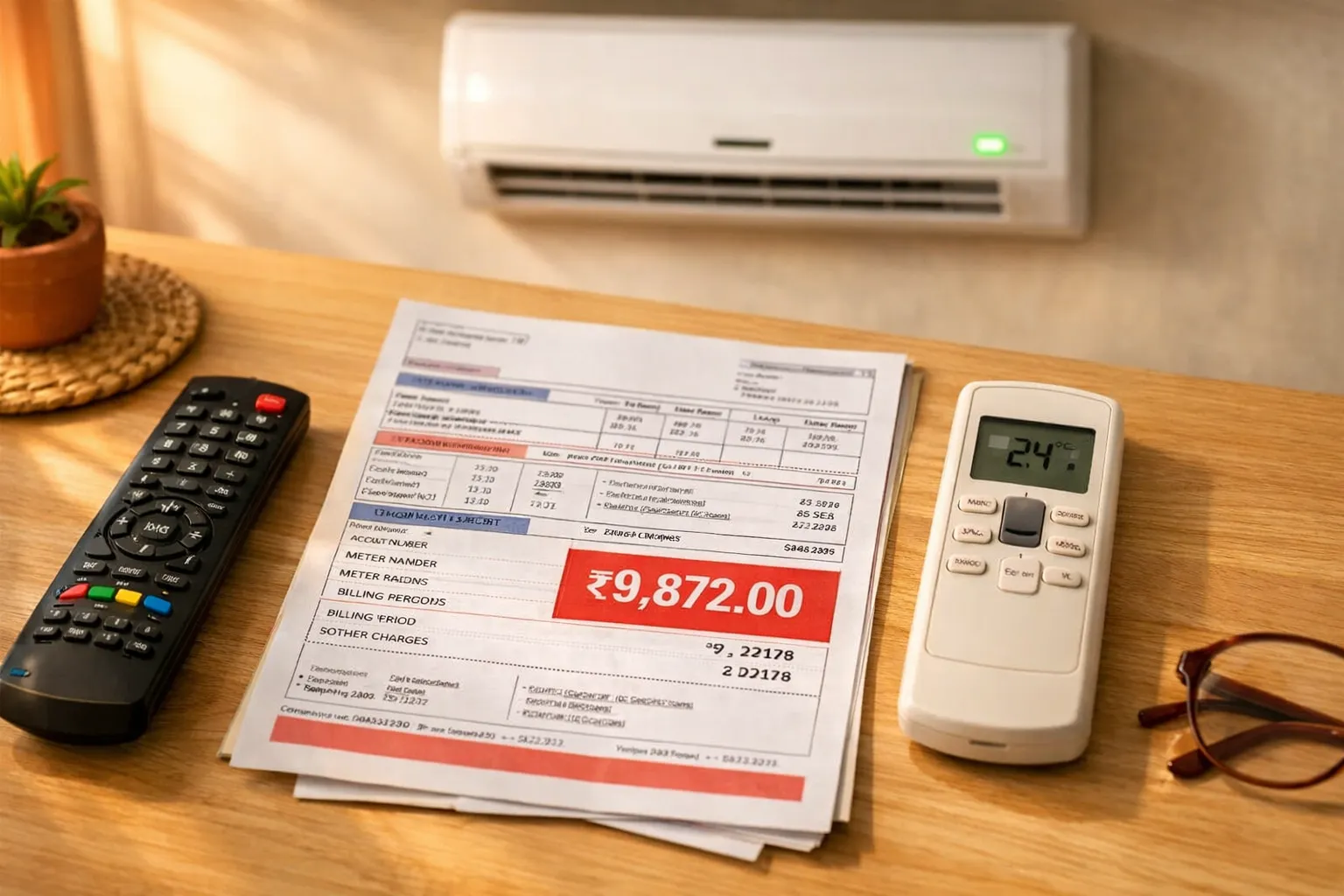
Key Takeaway
Your AC bill doubled not because electricity got expensive — but because of 5 fixable mistakes stacking on top of each other: dirty filters (+20–30%), wrong temperature (+48%), wrong tonnage (+20–40%), low refrigerant gas, and the electricity slab rate trap that silently doubles your per-unit cost.
The Bill That Made You Question Everything
June. The electricity bill arrives. You open it expecting the usual summer bump — maybe ₹500 more than April. Instead, the number staring back at you is double what you paid three months ago. You check the meter reading. You check the bill again. You blame the electricity board.
Then you do what every Indian household does: you yell at your kids for leaving the AC on, threaten to switch to a cooler, and spend 20 minutes on Google searching “why AC bill so high.”
Here is what Google will not tell you clearly: your AC bill did not double because electricity got expensive. Rates in most Indian states have barely moved in the last 2 years. Your bill doubled because of 5 specific, fixable mistakes — and most families are making all 5 at the same time, turning a ₹2,000 AC bill into a ₹5,000 nightmare.
What Your AC Should Cost vs What You Pay
A 1.5-ton 5-star inverter AC set to 24°C in a properly sized room, running 8 hours nightly. Here is the gap between what it should cost and what most people actually pay:
What It Should Cost
₹0
per month at 24°C, clean filters
What Most People Pay
₹0
per month with all 5 mistakes
Summer Waste
₹0
thrown away over a 5-month summer
The Myth vs The Reality
What People Believe
“AC just uses more power in summer — nothing I can do about it”
“Electricity rates went up, that is why my bill doubled”
“Setting AC to 16°C cools the room faster, so I use it briefly then turn off”
“My AC is only 2 years old — it does not need servicing yet”
“A bigger AC cools better and uses the same power”
What Actually Happens
Your AC’s rated wattage is fixed. What changes is how long the compressor runs — and that is 100% controllable.
Delhi rates: unchanged for 2+ years. Mumbai BEST rates actually dropped 9.8% in 2025-26.
Inverter ACs cool at the same speed regardless of set temperature. 16°C just means the compressor never slows down.
Dust clogs filters in 2–3 weeks during Indian summers. Even a 1-year-old AC needs monthly filter cleaning.
An oversized AC short-cycles (on-off-on-off), wasting energy on repeated startup surges.
The 5 Silent Bill Killers
Each of these adds 20–50% to your bill independently. Most households have at least 3 running simultaneously, which is how a ₹1,800 monthly bill becomes ₹5,000.
Dirty Filters
A clogged filter forces the blower motor to work harder and the compressor to run longer. In testing, dirty filters turned a 1.3 kWh AC into a 1.8 kWh one — a 38% spike.
Bill impact: +₹3,000–4,000/summer
Fix: 10-minute wash every 2–3 weeks
Wrong Temperature
BEE says every 1°C lower adds 6% to your bill. Setting 16°C instead of 24°C = 48% more power. The compressor never throttles down because the room never reaches 16°C.
Bill impact: +₹4,500–7,500/summer
Fix: Set to 24°C + ceiling fan
Wrong Tonnage
Undersized AC runs at 100% all night, never reaching set temperature. Oversized AC short-cycles — turning on/off repeatedly, wasting energy on startup surges each time.
Bill impact: +20–40% consumption
Fix: Match tonnage to room size
Low Refrigerant Gas
A slow leak means the compressor runs continuously trying to cool with insufficient gas. Signs: cool (not cold) air, ice on copper pipes, room never reaches set temperature.
Bill impact: +30–50% consumption
Fix: Gas top-up ₹1,500–2,500
The Slab Rate Trap
Indian electricity uses progressive slabs. In Delhi: first 200 units = ₹3/unit. Units 401–800 = ₹6.50/unit. Your AC pushes total consumption into higher slabs, and now everything — fridge, lights, fans — costs more per unit. Your consumption doubled, but your bill may have tripled.
Bill impact: the multiplier that makes everything else worse
Fix: reduce total consumption to stay in lower slabs
Why the Slab Rate Is the Real Villain
This is the one nobody talks about, and it is the reason your bill feels disproportionately high compared to how much more you actually used.
In winter, your household uses maybe 250 units. At Delhi rates, that costs roughly ₹600 for the first 200 units (at ₹3/unit) plus ₹225 for the next 50 (at ₹4.50/unit). Total: about ₹825.
In summer, with the AC running, consumption jumps to 600 units. Now the math changes completely: ₹600 for the first 200, ₹900 for the next 200 (at ₹4.50), and ₹1,300 for the remaining 200 (at ₹6.50). Total: ₹2,800.
Your consumption went from 250 to 600 — a 2.4x increase. But your bill went from ₹825 to ₹2,800 — a 3.4x increase. The slab structure added a full extra multiplier. And this is before adding fuel surcharge adjustments and fixed charges.
This is why small reductions in AC consumption have outsized effects on your bill. Cutting 100 units does not save you ₹3/unit (the lowest slab). It saves you ₹6.50/unit (the highest slab you are currently in). Every unit you save comes off the top.
Delhi Electricity Slabs
The per-unit cost more than doubles from the lowest to the highest slab. Every unit your AC wastes is billed at the highest slab you hit.
The Key Insight
Saving 100 units when you are at 600 units saves you ₹650 (at ₹6.50/unit). The same 100-unit saving when you are at 200 units saves only ₹300. Cutting waste at the top of the slab is 2x more valuable.
The 30-Minute Fix That Saves ₹5,000 Per Summer
You do not need to be an AC technician. These steps take 30 minutes total and can cut your summer AC bill by 25 to 40 percent. Do them this weekend.

Clean the filters — right now
Open the front panel, pull the mesh filters out, wash under running water, let dry for 15 minutes, slide back in. Do this every 2–3 weeks during summer. This single step saves 20–30% on your AC’s consumption. Set a phone reminder.
Set temperature to 24°C and leave it
Turn on a ceiling fan at medium speed alongside the AC. A fan at 70 watts with AC at 24°C feels like AC at 21°C without a fan. Lowering your AC by 3 degrees costs 300–500 watts — 4 to 7 times more energy than a ceiling fan for the same perceived cooling.
Check the outdoor unit
Is it in direct sunlight? Is the area clear of obstructions? The outdoor unit needs at least 1 foot of clearance on all sides to dissipate heat. A covered or blocked unit increases consumption by 10–15%. Remove any covers, boxes, or plants crowding it.
Seal the room and block sunlight
Close doors and windows. Use heavy curtains on sun-facing windows — direct sunlight adds 1,000–2,000 watts of heat load that your AC must fight. Curtains cost ₹1,500–3,000 and pay for themselves in one summer. Every gap is cold air escaping and hot air entering.
Book a pre-summer service
A professional deep clean of the evaporator coil, condenser coil, and drain line costs ₹1,500–2,000. The technician checks refrigerant levels and electrical connections. This ₹2,000 service saves ₹3,000–5,000 over the summer in reduced consumption and prevented breakdowns. Book it before April — prices go up once the rush starts.
When to Call a Technician Immediately
If your AC blows room-temperature air, if the compressor turns on and off every few minutes (short-cycling), if you see ice forming on the indoor or outdoor unit, or if the bill spiked by more than 40% compared to the same month last year — do not wait. These are signs of low refrigerant, a failing compressor, or an electrical fault. Professional diagnostics cost ₹500–1,000 and can prevent a ₹15,000 compressor replacement.
Go Deeper on ACs
Whether you are optimizing your current AC or shopping for a new one, these guides will save you money.
Stop Setting AC to 16°C
The full science of why 16°C wastes money without cooling faster.
AC Buying Guide
How to pick the right tonnage, star rating, and type for your room.
AC Tonnage vs BTU Explained
Size your AC correctly so the compressor is not fighting all night.
AC Not Cooling Enough?
Step-by-step troubleshooting for weak cooling.
Best 1-Ton 5-Star AC
Top picks if you are upgrading from a non-inverter.
Inverter AC Error Codes
Decode the blinking lights before calling a technician.
Tonight: wash the filters. Set it to 24. Close the curtains.
That is ₹5,000 back in your pocket this summer. All it costs you is 30 minutes.