
The Ice Trick That Makes Any Air Cooler 40% More Effective
You dumped a tray of ice into the tank. It helped for 30 minutes. Then the room was hot and humid. Here is what actually works — and the physics behind why.
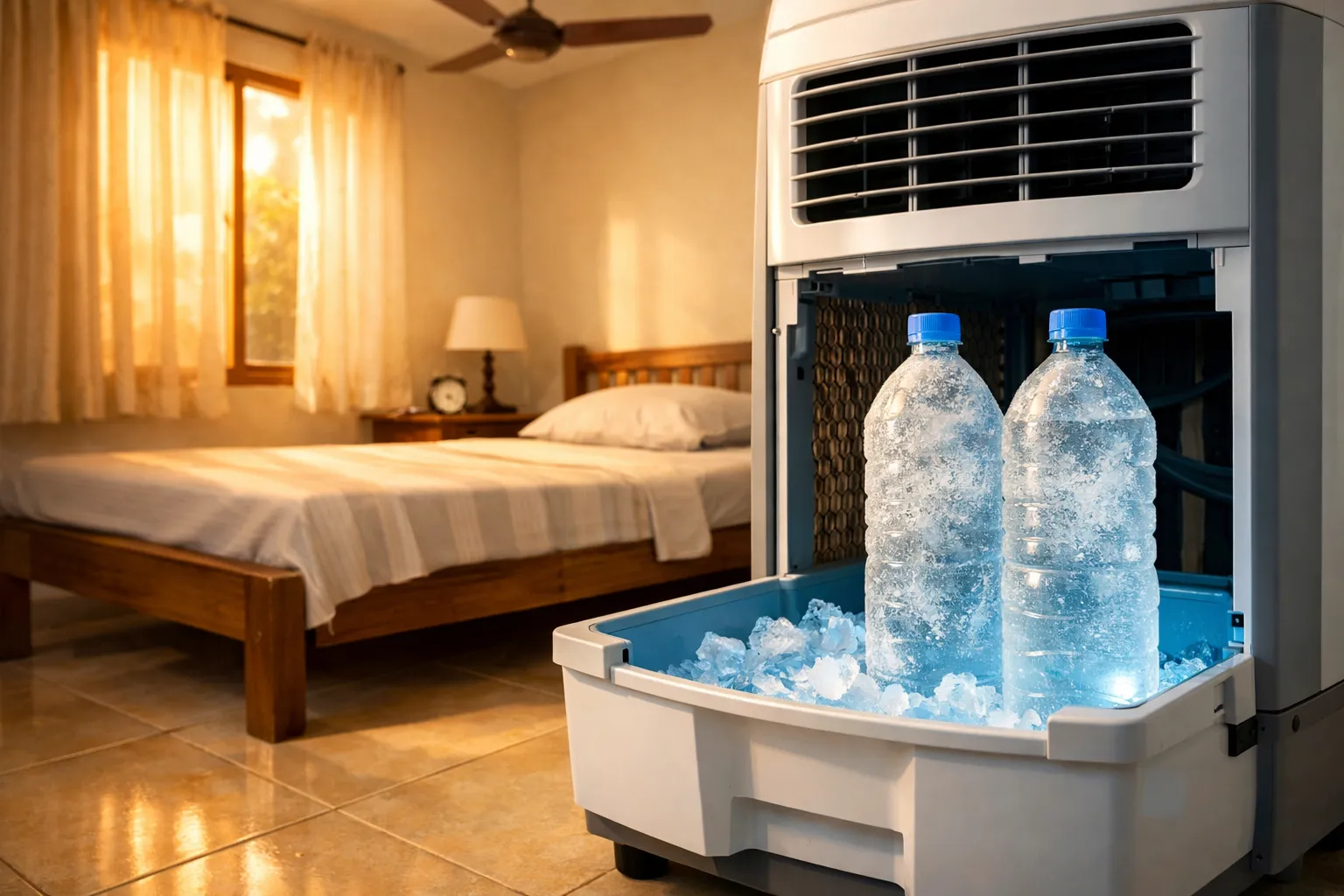
Key Takeaway
Loose ice in the tank gives you 1–3°C of cooling for 30–45 minutes — then it is gone. The real trick is a combo: frozen 2L bottles (reusable, no dilution), cross-ventilation (open a window on the opposite wall), and timing (run it when humidity is below 50%). Together, these push evaporative cooling from a 5°C drop to an 8–12°C drop.
You Filled the Tank With Ice. It Barely Helped.
May afternoon. The thermometer says 44°C. Your cooler is running on full blast but the air coming out feels like someone breathing on your neck. So you grab two ice trays from the freezer, dump them into the cooler tank, and wait.
For 20 minutes, magic. The air feels noticeably cooler. You tell your WhatsApp group about the hack. Then the ice melts. The water in the tank is now slightly cold instead of room temperature, and the extra water has diluted the tank. Within 45 minutes, you are back to square one — except now the room feels stickier because all that melted ice added moisture without adding cooling.
This is the most repeated air cooler hack on the internet. It is also the most misunderstood. Ice can help — but not the way you think. The problem is not the ice. The problem is that people use ice as the main cooling strategy instead of what it actually is: a small booster to evaporative cooling.
Your cooler already has a cooling engine — evaporation. It is 6.8 times more powerful than ice. The real trick is making that engine work at full capacity. Ice is the garnish, not the dal.
The Physics Your Cooler Manual Never Explained
Your air cooler works on one principle: evaporative cooling. Water soaks the pads, hot air passes through, and the water evaporates. That evaporation absorbs heat from the air, dropping the temperature.
Here is the number that matters: evaporating 1 kg of water absorbs 2,260 kJ of energy. That is the latent heat of vaporisation — the energy water pulls from the air as it transforms from liquid to vapour.
Now compare that to ice. Melting 1 kg of ice absorbs only 334 kJ. That is the latent heat of fusion. So evaporation is 6.8 times more powerful than ice melting as a cooling mechanism.
This is why just adding ice barely moves the needle. Your cooler’s pads are already evaporating litres of water every hour. That is where the real cooling comes from. When people say “ice made my cooler amazing,” what usually happened is they also opened a window, or the humidity happened to be low that day. The ice gets the credit. The physics says otherwise.
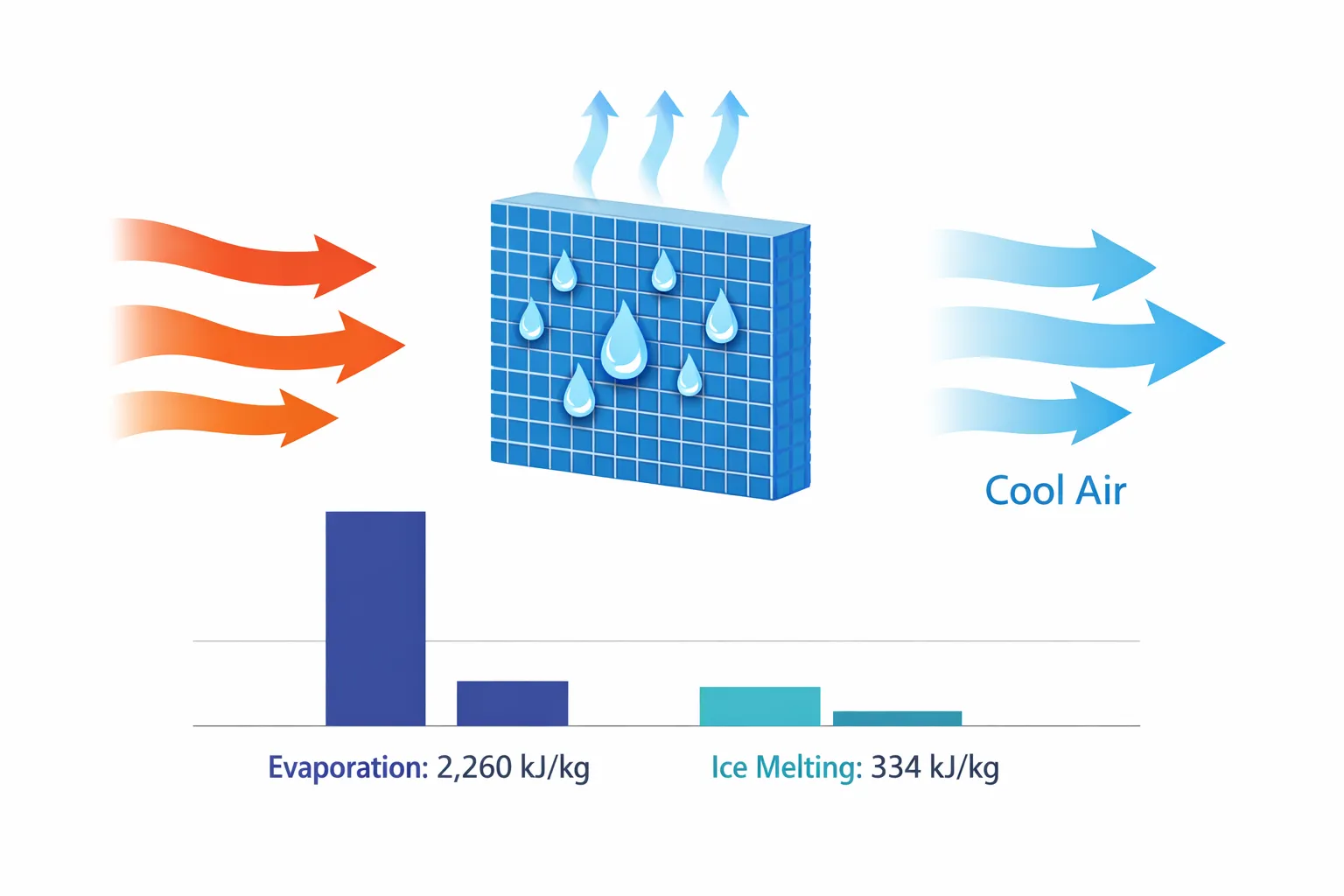
Cooling Power Comparison
Evaporation (1 kg water)
2,260 kJ
Ice Melting (1 kg ice)
334 kJ
Evaporation absorbs 6.8x more heat per kg than melting ice. Your cooler pads are already doing the heavy lifting. Ice is a minor supplement at best.
In Simple Terms
Imagine your cooler pads as a Rs 2,260 cooling machine. Dumping ice into the tank is like taping a Rs 334 table fan to it. Technically more cooling, but the ratio is laughable. Fix the main engine first.
The Numbers: Ice vs Evaporation
Ice Alone Drops Temp By
1–3°C
and lasts 30–45 min only
Evaporation Drops Temp By
8–15°C
continuously, if humidity <50%
Combo Method Drops
8–12°C
frozen bottles + ventilation + timing
Monthly Cost vs AC
₹0
vs ₹3,000–4,000 for a 1.5-ton AC
The Right Way to Use Ice (Frozen Bottles, Not Cubes)
The secret is not more ice. It is controlled cold that does not dilute your tank. Frozen 2-litre PET bottles sit in the tank, chill the water around them, and when they melt — you pull them out, refreeze, and repeat. No mess. No wasted cooling. Here is the exact method.
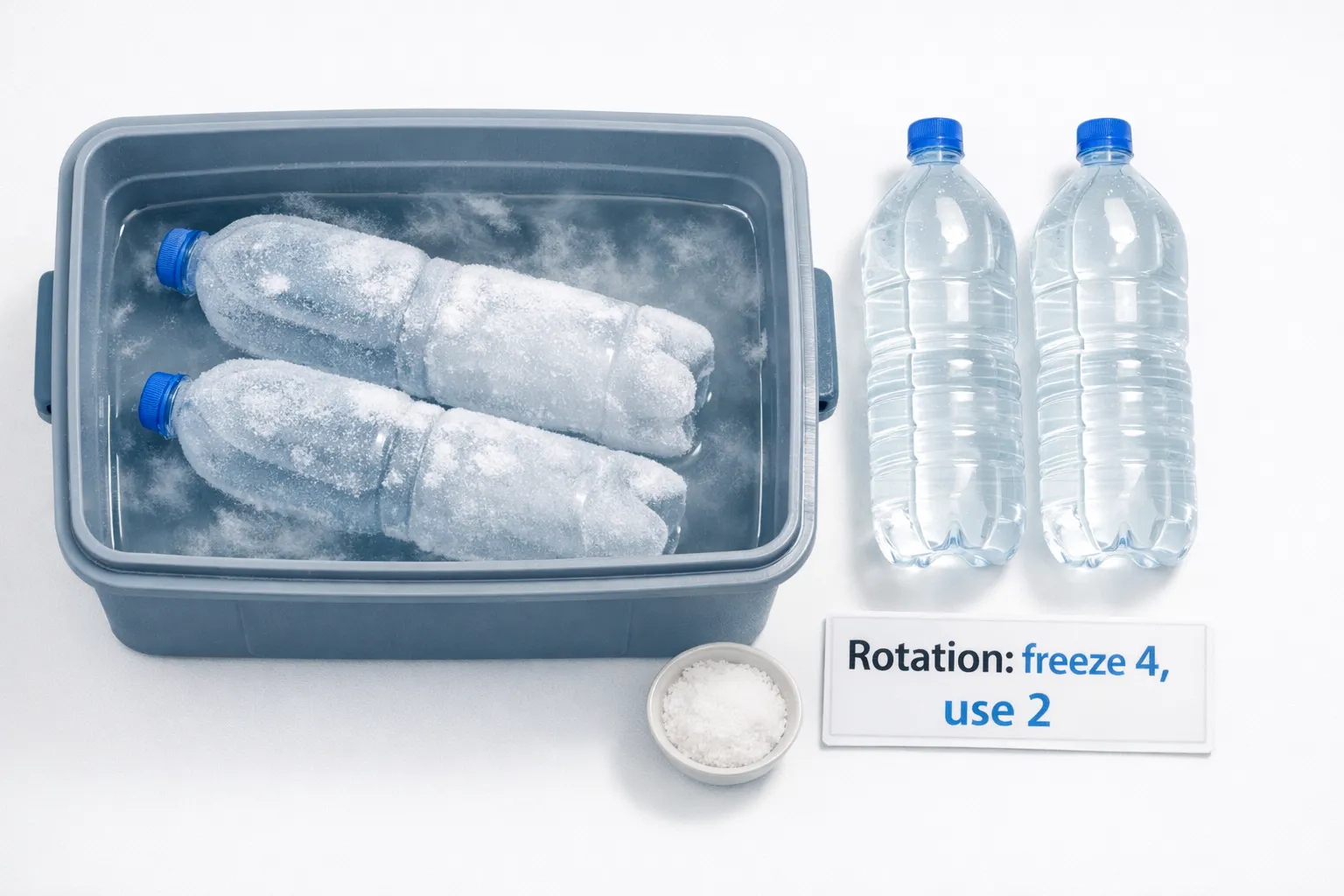
Fill 4–6 PET bottles (2L each) with water and a tablespoon of salt
Salt lowers the freezing point to about −2°C, so the bottles stay colder longer after you take them out. Use old Bisleri or Kinley bottles — they handle freezing fine. Leave 2 cm of space at the top for expansion.
Freeze overnight — keep a rotation of at least 4 bottles
While 2 bottles are in the cooler tank, 2 are refreezing. A standard Indian fridge freezer takes 8–10 hours to freeze a 2L bottle solid. Start the rotation the night before you need them.
Place 2 bottles in the cooler tank, submerged in the water
Drop them right into the water reservoir. The frozen bottles chill the surrounding water to 8–12°C — this cold water then soaks the pads, and the air blowing through gets an extra 2–3°C drop on top of normal evaporative cooling. Effect lasts 2–3 hours per pair of bottles.
Swap bottles every 2–3 hours during peak heat (12 PM to 5 PM)
When the bottles feel warm to the touch, pull them out and drop in the frozen pair from the freezer. This gives you continuous cold-water-boosted cooling during the worst hours. After 5 PM, regular evaporation is usually enough.
Why this beats loose ice: zero dilution, longer duration, reusable
Loose ice melts into the tank within 30–45 minutes, raising water level and diluting the cooling effect. Frozen bottles keep the cold contained — the water stays cold 4–6x longer, and you never add excess water to the tank. Plus, you reuse them every day for the entire summer. Total cost: ₹0.
The Ventilation Rule Nobody Follows
This is the single biggest reason coolers “do not work” in most homes. An air cooler adds moisture to the room. If that moisture has nowhere to go, humidity climbs past 70%, evaporation slows to a crawl, and your cooler becomes a fancy humidifier. The fix is free.
Closed Room (What Most People Do)
All windows and doors shut “to keep the cool air in”
Humidity climbs from 40% to 75%+ within 1 hour
Evaporation rate drops by 50–70%
Temperature drop: 3–5°C at best
Room feels clammy and sticky despite cooler running
You conclude “coolers do not work”
Result: Hot + humid. Worst combo.
Cross-Ventilated Room (The Right Way)
Cooler on one side, window open on the opposite wall
Humid air escapes through the open window
Fresh dry air continuously enters the cooler
Evaporation rate stays at full capacity
Temperature drop: 8–15°C in dry climates
Room feels dry and breezy — the way coolers are supposed to feel
Result: Cool + comfortable. This is the fix.
The rule: Open a window or door on the opposite wall from your cooler. The opening should be about 1–2 sq ft — enough to let moist air escape, not so large that you lose all the cooled air. If you have a ceiling fan, run it on low to help circulate the air across the room.
5 More Upgrades That Actually Work
Hang a Wet Khus Curtain
Hang a dampened khus (vetiver) curtain or even a wet cotton bedsheet on the window where hot air enters the cooler. The air gets a first-stage cooling before it even hits the pads. This pre-cooling can add 2–4°C extra drop to your cooler’s output. Re-wet the curtain every 2 hours.
Cost: ₹150–300 for a khus curtain
Time Your Cooler to Low Humidity
Evaporative cooling works best when relative humidity is below 50%. In cities like Jaipur, Delhi, and Ahmedabad, morning hours (6–11 AM) and late afternoon (3–7 PM) typically have lower humidity. Check humidity on your phone weather app. If it says 60%+, switch to fan-only mode.
Cost: ₹0 (just timing)
Upgrade to Honeycomb Pads
If your cooler uses wood wool (khas) pads, switching to honeycomb cellulose pads improves evaporation efficiency by 15–25%. The uniform structure holds water better and provides even air distribution. They last 2–3 seasons vs one season for wood wool.
Cost: ₹300–800 per set
Position It Next to the Window
Your cooler needs hot, dry air to work. Place it near a window or door that faces outside — so it pulls in fresh air, not already-humidified room air. Desert coolers placed in the centre of the room recirculate humid air and lose 30–40% of their cooling capacity.
Cost: ₹0 (just move it)
Clean Pads Every 2 Weeks
Mineral deposits from hard water clog pad pores over time, reducing water absorption by up to 40%. A 15-minute vinegar soak (50:50 with water) dissolves calcium buildup. Clean pads absorb more water, evaporate faster, and cool better. They also smell less.
Cost: ₹30 per session (vinegar)
When Ice Makes Things Worse
If your city’s humidity is already above 60% — like Mumbai, Chennai, Kolkata, or any coastal city during pre-monsoon — ice in the cooler is actively harmful. The extra cold water slows evaporation further, and the cooler just pumps moisture into an already humid room. You end up hotter and stickier than without the cooler.
The rule of thumb: If the air feels sticky before you turn on the cooler, the cooler will make it worse. Check humidity on your phone. Below 50% = cooler heaven. 50–60% = still works, reduced output. Above 60% = switch to a fan or AC. Coolers are designed for Rajasthan, Madhya Pradesh, and inland UP — not for coastal India.
More on Air Coolers
Whether you are optimising your current cooler or shopping for a better one, these guides have you covered.
Desert Cooler Smell Fix
The 2-minute habit that kills cooler stink permanently.
Air Cooler Buying Guide
How to pick the right type and size for your room.
Air Cooler Not Cooling?
Step-by-step troubleshooting for cooling and smell issues.
Air Coolers and Climate
Why coolers work in Rajasthan but not in Mumbai.
Best Air Coolers Under ₹10,000
Top picks with honeycomb pads and good tank capacity.
Portable Cooler Technology
How modern coolers work and what tech matters.
Tonight: freeze 4 bottles. Tomorrow: open the opposite window.
That is the whole hack. Not ice cubes in the tank. Frozen bottles, cross-ventilation, and a humidity check. Your cooler was always capable — it just needed the right conditions.