
Best Geyser & Water Heater in India 2026
Our top picks across every capacity and type - storage, instant and immersion. Compare prices, size the right tank for your family, and get safe fixes for the three most common geyser faults.
As an Amazon Associate we earn from qualifying purchases. We could also earn a fee through some links when you click on them.

The Best Geyser for Every Need
One standout pick per capacity and type - check the live price, or open the in-depth category review for more options.


Which Geyser Fits Your Home?
Find your household in the first column - it tells you the right type and size before you ever look at brands, then points you to our pick and the full ranking for that category.
| YOUR SITUATION | GET THIS | OUR PICK | PRICE | FULL RANKING |
|---|---|---|---|---|
| Couple or single, one main bathroom | 10L storage | Bajaj New Shakti 10L 5 Star | ₹6,599 | Review → |
| Household of 2-3, daily showers | 15L storage | AO Smith SGS-GREEN-015 | ₹11,499 | Review → |
| Family of 4+, back-to-back showers | 25L storage | Bajaj Shield New Shakti 25L | ₹7,424 | Review → |
| Compact bathroom, tight wall space | 6L storage | AO Smith SGS-Plus-006 | ₹8,699 | Review → |
| Kitchen sink, basin or guest bath | 3L instant | Havells Instanio | ₹3,699 | Review → |
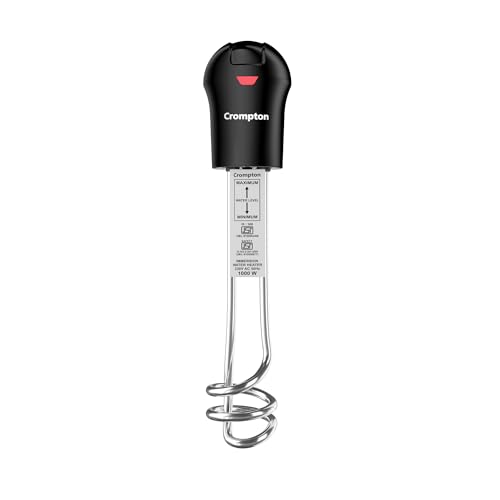
| Rental, hostel or winter backup | Immersion rod | Crompton AIMR-SP15A 1500W | ₹699 | Review → |
Which Type of Water Heater Should You Buy?
The type decision sets your electrical requirements, running cost and daily routine. (A fourth option - gas geysers running on LPG/PNG - suits homes with unreliable power, but needs a ventilated bathroom.)
Instant vs Storage Geyser: Head-to-Head
Storage wins for most homes - 2 kW power on a normal 16A socket, consistent winter showers, and better hard-water handling. Keep a 3L instant unit for the kitchen sink or basin, or a 6 kW instant with a 32A circuit for showers in warm cities.
| ASPECT | INSTANT (3-6L) | STORAGE (10-25L) |
|---|---|---|
| Electrical load | High - 3-6 kW, needs a 20-32A MCB | Lower - 2 kW on a normal 16A socket |
| Heat-up time | Near-instant at low flow | 10-15 min (10L), 20-35 min (15-25L) |
| Winter showers | Struggles at 10-15°C inlet water | Consistent for 1-2 showers per cycle |
| Hard water | Narrow waterways can clog with scale | Anode rod + glass-lined tank resist scale |
| Standby loss | None | Low on PUF-insulated tanks |
| Best for | Basin, kitchen, guest bath (warm cities) | Main & family bathrooms, cooler climates |
Vertical vs Horizontal Geyser
Choose vertical for about 90% of Indian bathrooms - better thermal stratification means more consistent hot water, plus simpler mounting and easier service. Pick a purpose-built horizontal geyser only when vertical clearance is tight (false ceiling under 7 feet, above a door, or on a loft). Never lay a vertical unit on its side.
| ASPECT | VERTICAL | HORIZONTAL |
|---|---|---|
| Placement | Needs vertical clearance; hangs taller | Fits under low false ceilings and lofts |
| Hot-water consistency | Strong stratification - more consistent | Good if well designed; slightly more mixing |
| Installation | Common brackets, straightforward | Needs correct L/R orientation, firm anchoring |
| Choice & price | Wider choice, often cheaper | Fewer models, often pricier |
| Best for | Standard bathrooms with headroom | Low-height and above-door installs |
How to Choose a Geyser in India
Once you have picked a type, six factors decide whether your geyser runs cheaply and safely for a decade. Size to your peak usage - the people who bathe within the same two-hour window.
1-2 people: 10-15L · 3-4 people: 15-25L · 4-6 people: 25-35L · 6+: 35-50L. Budget 8-12L of hot water per quick shower and 15-20L per bucket bath, then add a 20% buffer if people bathe back-to-back. Too small means cold-water surprises; too large wastes power keeping unused water hot.
BEE stars measure how well the tank holds heat. On a 25L geyser, 5-star costs ₹3,000-3,800 a year to run vs ₹4,500-5,500 for 3-star - roughly ₹1,500-2,000 saved every year, paying back the premium in 2-3 years. High-density PUF insulation cuts heat loss by 50-70%.
In hard-water cities a corrosion-resistant tank is effectively mandatory. Stainless steel (304/316) or glass-lined tanks last 10-15 years versus 3-6 for basic coated tanks, and a magnesium anode rod sacrifices itself to protect the tank. The ₹3,000-5,000 premium pays back in avoided replacements.
A 2 kW storage geyser runs on a regular 16A socket. Instant units need 3-6 kW with a 20-32A MCB and matching wire gauge - check your bathroom circuit before buying, because an undersized MCB or thin wiring will trip or overheat.
Non-negotiable: a pressure-release safety valve (never block it), proper earthing with an ISI-marked ELCB/RCCB, a thermal cut-out, and an auto thermostat cut-off. These are what stand between a routine fault and a serious accident.
Always use professional installation - DIY can void the warranty. Fit a pressure-reducing valve if incoming pressure is high. Service yearly in soft-water areas and every 6 months in hard water: descale, clean the element, check the anode rod and test the safety valve (₹500-1,500).
Common Geyser Problems & Safe Fixes
The three faults every geyser owner eventually meets - and how to fix them without risking a shock, a fire, or a burst tank. When in doubt, switch off at the MCB and call a professional.
Geyser not heating water
Safety first: switch the geyser off at the MCB before touching any wiring or covers. If it is under warranty, or you see scorch marks or smell burning, call a professional instead of opening it.
| LIKELY CAUSE | FIX |
|---|---|
| Thermostat tripped or faulty | Reset it; replace the thermostat capsule if it will not hold |
| Heating element burnt or scaled | Descale, or replace the element if burnt out |
| Limescale on element or tank | Descale per the manual; descale taps and shower head too |
| Reversed hot/cold plumbing | Check connections; test by closing the cold feed |
| Undersized for winter usage | Stagger use, raise the setpoint, or upgrade capacity |
| Low or fluctuating voltage | Wait for stable supply or add a stabiliser |
Safety valve leaking water
- 5-20 warm drops during an active heating cycle
- Stops once the set temperature is reached
- About 50-200ml a day in total
- This is expected thermal-expansion relief
- Continuous flow even when the geyser is OFF
- More than 500ml a day, or cold-water dripping
- Steam discharge - overheating: turn off, call a pro
Never block the valve to stop it dripping - it is your only protection against a tank explosion. Fix the underlying cause instead:
- High incoming pressure (>3 bar): fit a pressure-reducing valve (₹1,000-2,500)
- Closed plumbing (check valves/pump): add an expansion tank (₹1,500-3,000)
- Stuck or worn valve: replace it (₹800-1,500 total)
- Overheating (steam, >90°C): replace a failed thermostat
Geyser trips the MCB or ELCB
Identify which tripped first: an MCB (per-circuit switch with an amp rating) trips on overload or short circuit; an ELCB/RCCB (the switch with a TEST button) trips on earth leakage - a genuine shock hazard. If the ELCB keeps tripping, stop using the geyser until an electrician megger-tests the element, even if it seems to work.
| CAUSE | FIX |
|---|---|
| Element earth leakage (ELCB trip) | Replace the leaking heating element |
| Water in the electrical compartment | Dry out, fix the leak, then re-test insulation |
| Undersized MCB (MCB trip) | Upgrade to 16A - but only if the wire gauge allows |
| Loose wiring / poor connections | Tighten terminals (electrician) |
| Faulty thermostat (trips after 10-15 min) | Replace the thermostat; descale if scaled |
| Faulty ELCB (nuisance trip - rare) | Confirm with a leakage tester before replacing |
Frequently Asked Questions
Go Deeper: Our Geyser Reviews by Capacity & Type
Each category review compares the current best models on price, tank material, warranty and hard-water suitability.
The most popular capacity - our full ranking for the standard main bathroom with 1-2 users.
Read review → STORAGE · 15 LFamily-bathroom tanks with the best hard-water durability per rupee.
Read review → STORAGE · 25 LBig tanks for large families and back-to-back showers, from ₹6,999.
Read review → STORAGE · 6 LCompact storage geysers for single users and tight bathrooms.
Read review → INSTANT · UNDER ₹5,0003L tankless units for kitchen sinks, basins and guest baths - Havells, ACTIVA and AO Smith compared.
Read review → IMMERSION RODSBucket-heating rods from ₹455, ranked for safety, durability and heating speed.
Read review →