Our top picks at every size from 32 to 85 inches - LED, QLED, Mini-LED and OLED. Match the size to your viewing distance, compare prices, then dive into the full size review.
32" to 85" OLED & Mini-LED Streaming devices Updated 10 Aug 2026
As an Amazon Associate we earn from qualifying purchases. We could also earn a fee through some links when you click on them.
The Quick Answer
BEST OVERALL
For most living rooms, the LG OLED evo C5 55" is the best TV in India right now - perfect OLED blacks, 120Hz with full HDMI 2.1 gaming and a 3-year warranty at around ₹1,19,990, at the size that fits the typical 8-10 ft sofa distance.
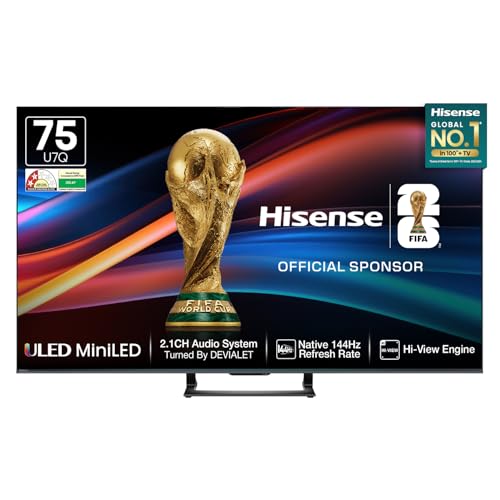
On a value budget, the Vu Vibe QLED 43" (₹26,490) pairs a 4K QLED panel with an 88W built-in soundbar, and the Sony BRAVIA KD-32W825 (₹28,990) is the most complete bedroom TV. Going big? The Hisense 75U7Q (₹99,999) is the 75-inch value king, and the Sony BRAVIA 9 85" (₹4,79,590) is the no-compromise flagship.
Find your viewing distance in the first column - it tells you the right
size before you ever look at brands, then points you to our pick and the
full ranking for that size.
Size first, panel second, everything else third. Measure your seating distance before you look at a single model - the right size at a modest panel beats the wrong size at any price. For the deep dive on panels, HDR formats, refresh rate and ports, read our full TV buying guide.
● Size & viewing distance
Measure sofa-to-screen and work backwards: 4-6 ft suits 32", 6-8 ft suits 43", 8-10 ft suits 55", 10-12 ft suits 65", and 12+ ft opens up 75-85". For 4K content you can sit closer than the old thumb rules - most Indian living rooms comfortably take one size larger than intuition suggests. Undersizing is the most common and most regretted TV mistake.
● Panel tech by budget
Panel type follows price more than preference: basic LED dominates under ₹30,000; QLED adds brighter, richer colour from roughly ₹25,000-70,000; Mini-LED brings deep contrast with high brightness from about ₹70,000; and OLED delivers perfect blacks from about ₹1,00,000. Buy the best panel your size-budget combination allows rather than a bigger TV with a weaker panel - unless you sit far away, where size wins.
● Smart OS
The OS decides your daily experience more than any picture spec. Google TV has the largest app library and the best universal search; webOS (LG) and Tizen (Samsung) are polished but more closed; budget systems like VIDAA cover the big apps but miss niche ones. Check RAM and storage too - 8GB-storage TVs fill up after a dozen app installs, and a slow OS is the main reason TVs feel old in three years.
● Sound reality-check
Slim panels mean almost every TV has mediocre sound - 20W down-firing speakers are the norm, fine for news and serials but thin for movies. A handful of models (like Vu with an 88W integrated soundbar, or the BRAVIA 9 with actuator audio) are genuine exceptions. For everything else, add a soundbar under ₹10,000 for smaller or budget sets, or one under ₹20,000 for larger living rooms, and treat the TV purchase as a picture purchase.
● Gaming features
Console gamers on a PS5 or Xbox Series X should insist on 120Hz native refresh, HDMI 2.1 bandwidth, VRR and ALLM - the combination that delivers 4K/120fps with no tearing and auto low-latency. These now appear from the mid-range up (and 144Hz on TVs like the Hisense U7Q). Casual and cable-TV viewers can ignore all of it: a good 60Hz panel with low input lag is plenty, and "Motion Rate" numbers are marketing, not refresh rate.
Frequently Asked Questions
What TV size should I buy for my viewing distance?
Measure the distance from your seating to the TV wall and match it to the size band: 4-6 feet suits a 32-inch, 6-8 feet suits a 43-inch, 8-10 feet suits a 55-inch, 10-12 feet suits a 65-inch, and 12 feet or more comfortably takes a 75- or 85-inch. With 4K panels you can sit closer than the old HD-era rules suggested, so when a room falls between two bands, choose the larger size - a slightly-too-big TV stops feeling big within a week, while a too-small one disappoints for years.
How much should I spend at each size?
Good TVs start around ₹10,000-15,000 at 32 inches, ₹22,000-30,000 at 43 inches for a 4K QLED, ₹35,000-60,000 at 55 inches (with OLED from about ₹1,00,000), ₹60,000-2,00,000 at 65 inches depending on panel, and ₹70,000-1,30,000 for a strong 75-inch, with 85-inch spanning ₹1,30,000 for value QLEDs to nearly ₹5,00,000 for flagship Mini-LED. The pattern: each size has a value tier and a premium tier, and the premium buys panel technology - not size. Decide the size from your room first, then spend what the panel quality is worth to you.
OLED, QLED, Mini-LED or LED - what does each panel type mean?
They describe how the picture is lit. LED is the baseline: an LCD panel lit by a uniform backlight - affordable, but blacks look grey. QLED adds a quantum-dot layer to an LED backlight for brighter, richer colour. Mini-LED shrinks the backlight into thousands of tiny zones that dim independently, giving near-OLED contrast with very high brightness. OLED needs no backlight at all - every pixel emits its own light, so blacks are perfect and contrast is infinite, at the cost of lower peak brightness and higher prices. Broadly: LED rules the budget tiers, QLED the mid-range, and Mini-LED and OLED compete at the premium end.
What refresh rate and HDMI features do gamers need?
For a PS5 or Xbox Series X, the checklist is: a native 120Hz panel, HDMI 2.1 ports with enough bandwidth for 4K at 120fps, VRR (variable refresh rate) to stop screen tearing, and ALLM to switch to low-latency game mode automatically. Some 2026 TVs push to 144Hz, which also benefits PC gamers. Be careful of marketing: "Motion Rate 120" or "MEMC" on a 60Hz panel is interpolation, not real refresh rate (our Motion Rate vs refresh rate explainer has the full breakdown). If you only game casually or on older consoles, a 60Hz TV with a decent game mode is genuinely enough.
Do smart TVs become slow, and can I fix it?
Yes - it is the most common complaint from year two onward. TV processors are modest, storage is small (often 8GB), and OS and app updates get heavier each year, so menus lag and apps crash long before the panel degrades. You can delay it by uninstalling unused apps and clearing caches, but the real fix is a ₹3,000-6,000 streaming stick or box: plug in a Fire TV Stick or Google TV Streamer, and it takes over all apps with a faster chip while the TV serves as a pure display. This is also the cheapest way to make an older non-smart or slow TV feel new.
When do TV prices drop in India?
TV discounts follow a reliable calendar. The deepest cuts come during Diwali-season sales - Amazon Great Indian Festival and Flipkart Big Billion Days in September-October - with Republic Day, Holi and Independence Day sales close behind. Prices also fall 20-30% when a new model year launches (typically March-June), making the outgoing generation the best value of the cycle. Big-screen TVs additionally spike in discounts before cricket marquee events like the IPL and World Cups. The worst time to buy is at a new model’s launch price.
Go Deeper: Our TV Reviews by Size
Each size review tests and ranks the full field - with in-depth verdicts, panel comparisons and buying advice for that size.