
PRODUCT REVIEW
Best 1.5 Ton 5 Star Inverter Split AC in India 2026
11 best 1.5 ton 5 star inverter split ACs in India 2026 compared — IFB (WWCD winner, 644 kWh/yr), Midea value pick, Cruise budget, Carrier, Hitachi.
 By Naveen Bhavnani
Updated
By Naveen Bhavnani
Updated
As an Amazon Associate we earn from qualifying purchases. We could also earn a fee through some links when you click on them.

A note on Daikin
Daikin has been our top pick for a long time, and we still believe it has the best cooling efficiency of any product here. Its recent reviews, however, tell a different story: a notable share of units are arriving damaged, and buyers report that Daikin's after-sales service has been slow to resolve these issues. We have factored this recent-reliability signal into the rankings — the Daikin is still an excellent machine, but inspect the unit carefully on delivery and confirm local service before you buy.
5 star AC picks by price and reach
Already covered the winner above — here are the picks for specific needs.

Midea 1.5 Ton 5 Star Inverter Split AC (Wi-Fi, 6-in-1, 52°C Heavy Duty Cooling, HD+PM2.5, MAI18SR5R36W0)
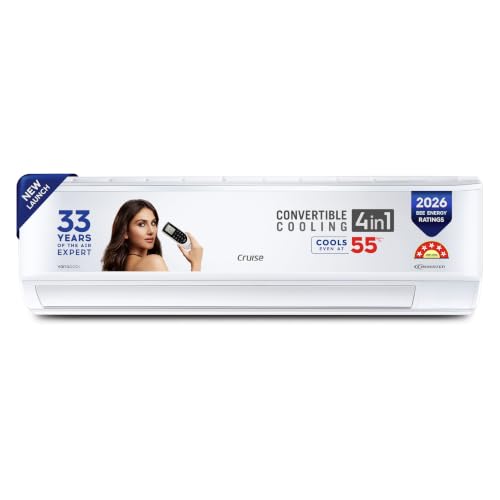
Cruise 1.5 Ton 5 Star 2026 New Star Rated Inverter Split AC (4-in-1, Cools @55°C, Anti-Rust, EEV, CWCVBM-VP3F185)

Hitachi 1.5 Ton 5 Star New Star Rated Inverter Split AC (Smart View Display, 24m Air Throw, ice Clean, RAS.V518PCDIBT)
5 star ACs compared on kWh/yr
How the shortlist stacks up. Scroll sideways on mobile.
| WWCD Score | Product | ISEER | Annual kWh/yr | Noise (dB) | Wi-Fi | Price | Deal |
|---|---|---|---|---|---|---|---|
| 8.6/10 | IFB CI195SS32SGM3 | 5.65 | 644 | 39 | Yes | ₹42,490 | Check Price |
| 8.5/10 | Midea MAI18SR5R36W0 | 5.60 | 663 | 38 | Yes | ₹38,990 | Check Price |
| 8.4/10 | Carrier ESTER EDGE Gxi | 5.60 | 663 | 38 | No | ₹43,990 | Check Price |
| 8.3/10 | Hitachi RAS.V518PCDIBT | 5.60 | 691 | 37 | No | ₹45,500 | Check Price |
| 8.3/10 | Panasonic HU18CKY5X | 5.80 | 704 | 34 | Yes | ₹53,980 | Check Price |
| 8.2/10 | Daikin MTKM50XV16 | 5.70 | 679 | 31 | No | ₹48,990 | Check Price |
| 8.1/10 | Blue Star IA518ZXUS | 5.63 | 702 | 45 | Yes | ₹47,490 | Check Price |
| 7.9/10 | Cruise VP3F185 | 5.71 | 651 | 39 | No | ₹35,990 | Check Price |
| 7.8/10 | LG AS-Q19YNZE1 | 5.77 | 671 | 31 | Yes | ₹47,990 | Check Price |
| 7.7/10 | Lloyd GLS18I5AGGGW | 5.75 | 646 | 37 | No | ₹43,990 | Check Price |
| 7.1/10 | Acerpure Chill Neo | 5.65 | 699 | 42 | No | ₹42,590 | Check Price |


Important: BEE Star Rating Changes for 2026
The Bureau of Energy Efficiency (BEE) has revised star rating criteria for 2026. The new 5-star threshold requires ISEER 5.60 or higher (previously 5.00). Models with ISEER 5.00–5.59 are now 4-star under 2026 norms.
What this means for this review: Every one of our 11 picks is a genuine 2026 "New star rated" 5-star with ISEER between 5.60 and 5.80, verified from each unit's energy label. We rejected older-rating SKUs that earned their 5-star under the previous, easier table. Our WWCD winner: IFB CI195SS32SGM3 — a true 5-star (ISEER 5.65) with the lowest running cost (644 kWh/year) and the healthiest recent-review profile in the field.
Full Transparency: Each product below shows its BEE star rating and ISEER. Understand ISEER & star ratings to compare models yourself.
1.5 ton 5 star AC reviews: ISEER, running cost and reach
Specs, the honest pros and cons, and who each one is for.
IFB 1.5 Ton 5 Star New Star Rated AI Powered Inverter Split AC (Inbuilt Wi-Fi, Hybrid, 8-in-1 Flexi, CI195SS32SGM3)
The efficiency-and-features champion — lowest bills, richest features, healthiest reviews.
- BEE Star Rating (2026)
- 5 Star (New Star Rated)
- ISEER
- 5.65
- Annual Energy
- 644 kWh/year (lowest)
- Cooling Capacity
- 4.7 kW
- Noise Level
- 39 dB (buyers report silent)
- Refrigerant
- R-32
- Smart
- Inbuilt Wi-Fi + AI
- Convertible Modes
- 8-in-1 Flexi + Hybrid
- Filter
- Dust Filter + Self Clean
- Condenser
- 100% Copper
- Warranty
- 1yr / 5yr PCB / 10yr compressor
- Model
- CI195SS32SGM3
IFB tops the field by pairing the lowest running cost (644 kWh) with a Wi-Fi/AI/Hybrid feature set and the healthiest recent-review profile of any 5-star here. The one caveat is IFB's thinner AC service network — a real consideration if you value on-ground support.
- + Lowest running cost in the field at 644 kWh/year (ISEER 5.65)
- + Highest Amazon rating (4.4) on a solid 253-review base
- + Healthiest recent-review profile — only 20% recent-negative
- + Inbuilt Wi-Fi + AI + Hybrid + 8-in-1 convertible feature set
- + Reviewers repeatedly call it silent despite the 39 dB rating
- + Fast cooling and quick committed installation reported
- - Weak IFB AC service network — buyers flag 'no engineer / slow response'
- - 39 dB rated noise higher on paper than the 31 dB Daikin/LG
- - One buyer reported the unit always running at peak power draw
- - Outdoor-unit noise mentioned by a couple of buyers
Midea 1.5 Ton 5 Star Inverter Split AC (Wi-Fi, 6-in-1, 52°C Heavy Duty Cooling, HD+PM2.5, MAI18SR5R36W0)
The value smart-AC — Wi-Fi, powerful cooling and silence for the lowest price here.
- BEE Star Rating (2026)
- 5 Star (New Star Rated)
- ISEER
- 5.60
- Annual Energy
- 663 kWh/year
- Cooling Capacity
- 4.8 kW (52°C heavy duty)
- Noise Level
- 38 dB (buyers report super silent)
- Refrigerant
- R-32
- Smart
- Wi-Fi + Voice Control
- Convertible Modes
- 6-in-1 + Turbo
- Filter
- HD + PM2.5 + Auto Clean
- Condenser
- 100% Copper + Blue Coating
- Warranty
- 1yr / 10yr compressor
- Model
- MAI18SR5R36W0
Midea delivers a Wi-Fi 5-star with genuinely powerful, silent cooling for ₹38,990 — the best value in the field. It rides Carrier's efficient platform; the only real caveat is a thin review base, so it is less proven than the 200+ review picks.
- + Cheapest Wi-Fi model in the field at ₹38,990
- + Powerful cooling — buyers say it 'cools like a 2-ton'
- + Super-silent operation confirmed by verified reviews
- + Healthy 20% recent-negative review profile
- + Low installation cost and good installer service reported
- + Same efficient manufacturing platform as Carrier India
- - Thin 63-review base and low sales velocity — reliability less validated
- - One buyer reported low cooling and a poor service-centre experience
- - One report of an indoor 'tuk tuk' rattle and poor packaging
- - Base warranty is 1yr — longer cover needs a paid extension
Carrier 1.5 Ton 5 Star New Star Rated Flexicool Inverter Split AC (6-in-1, Smart Energy Display, PM2.5, ESTER EDGE Gxi-CAI18EE5R36F0)
The dependable all-rounder — quiet, efficient and validated by hundreds of buyers.
- BEE Star Rating (2026)
- 5 Star (New Star Rated)
- ISEER
- 5.60
- Annual Energy
- 663 kWh/year
- Cooling Capacity
- 4.8 kW (Insta Cool)
- Noise Level
- 38 dB (buyers call it quiet)
- Refrigerant
- R-32
- Smart
- Smart Energy Display (no Wi-Fi)
- Convertible Modes
- 6-in-1
- Filter
- PM2.5 / HD + Auto Clean
- Condenser
- 100% Copper
- Warranty
- 1yr / 10yr compressor (extended PCB)
- Model
- CAI18EE5R36F0
Carrier is the safe, balanced choice: quiet and efficient with one of the healthiest recent-review profiles in the field and a real 219-review track record. You give up Wi-Fi, but nothing about it raises a red flag.
- + One of the healthiest recent-review profiles — 20% recent-negative
- + Solid market-validated 219-review base
- + Verified buyers praise it as quiet and efficient
- + Smart Energy Display shows live running cost
- + Smooth cooperative installation reported
- + Good value at ₹43,990 on an efficient 663 kWh platform
- - No Wi-Fi / app control
- - Base warranty 1yr — 5yr PCB needs a paid extension
- - One unit reportedly stopped working in the second month with slow brand support
- - One incomplete delivery (remote/accessories missing)
Hitachi 1.5 Ton 5 Star New Star Rated Inverter Split AC (Smart View Display, 24m Air Throw, ice Clean, RAS.V518PCDIBT)
The big-room cooler with a real service network behind it.
- BEE Star Rating (2026)
- 5 Star (New Star Rated)
- ISEER
- 5.60
- Annual Energy
- 691 kWh/year
- Cooling Capacity
- 5 kW
- Air Throw
- 24 m (best reach)
- Noise Level
- 37 dB (noisy on high speed)
- Refrigerant
- R-32
- Convertible Modes
- ice Clean + Octa Sensor
- Filter
- Anti-Bacterial + Pre-Filter
- Condenser
- 100% Copper
- Warranty
- Base + paid 5yr extension
- Model
- RAS.V518PCDIBT
Hitachi's 24m air throw gives it the best cooling reach here, backed by a deep AC service network and a healthy review record. The trade-offs are a paid warranty extension, higher running cost and some high-speed noise.
- + Best cooling reach — 24m long air throw for larger/longer rooms
- + Strong even cooling praised by verified buyers
- + Deep Hitachi AC service network — installation and service praised
- + Healthy 20% recent-negative on a solid 185-review base
- + Smart View display + Octa Sensor + anti-bacterial filter
- - Warranty is a PAID 5yr extension (₹299+GST) not free
- - Noisy on high fan speed per several buyers
- - 691 kWh — higher running cost than the efficiency leaders
- - No Wi-Fi / app control
- - One Smart-View display failed after a month
Panasonic 1.5 Ton 5 Star New Star Rated Premium Wi-Fi Inverter Smart Split AC (nanoe, Matter, DustBuster, 8-in-1, CS/CU-HU18CKY5XFMH-P)
The premium, air-purifying smart flagship — if features trump price and track record.
- BEE Star Rating (2026)
- 5 Star (New Star Rated)
- ISEER
- 5.80 (highest)
- Annual Energy
- 704 kWh/year (highest)
- Cooling Capacity
- 5 kW (higher airflow)
- Noise Level
- 34 dB + silent mode
- Refrigerant
- R-32
- Smart
- Wi-Fi + Matter/MirAIe + AI
- Convertible Modes
- 8-in-1 + 4-way + AI
- Filter
- nanoe + PM (best filtration)
- Condenser
- 100% Copper
- Warranty
- 1yr / 5yr PCB / 10yr compressor
- Model
- CS/CU-HU18CKY5XFMH-P
Panasonic is the features-and-air-quality flagship: nanoe purification, Matter, Wi-Fi and the highest ISEER. But it is the priciest here, its real-world energy use is the highest, and a thin 32-review base with damaged-on-arrival complaints leaves reliability unproven.
- + Best filtration and air quality in the field — nanoe + PM
- + Feature leader — Matter smart-home + Wi-Fi + 8-in-1 + 4-way swing
- + Highest ISEER on paper (5.80)
- + Very fast cooling with high airflow
- + Quiet 34 dB with a dedicated silent mode
- - Most expensive in the field at ₹53,980
- - Highest actual annual energy (704 kWh) despite the top ISEER headline
- - Thin 32-review base — reliability unproven
- - 30% recent-negative — damaged/used units on arrival and poor Panasonic service
- - Only a basic 1yr comprehensive cover as standard
Daikin 1.5 Ton 5 Star New Star Rated Inverter Split AC (3D Airflow, PM2.5, MTKM50XV16)
Superb, whisper-quiet cooling — shadowed by a recent run of damaged-on-arrival units.
- BEE Star Rating (2026)
- 5 Star (New Star Rated)
- ISEER
- 5.70
- Annual Energy
- 679 kWh/year
- Cooling Capacity
- 5 kW (3D Airflow)
- Noise Level
- 31 dB (quietest)
- Refrigerant
- R-32
- Smart
- No Wi-Fi (Triple Display)
- Convertible Modes
- 3D Airflow + Coanda
- Filter
- PM2.5
- Condenser
- 100% Copper + DNNS coating
- Warranty
- 1yr / 5yr PCB / 10yr compressor
- Model
- MTKM50XV16
Daikin still delivers the quietest, among the best cooling here with a strong service network. But it drops from its former top spot: 40% of its most-recent verified buyers report damaged or defective units on arrival, a reliability signal that overrides its healthy lifetime rating.
- + Excellent fast cooling — Daikin's signature strength
- + Quietest in the field at 31 dB — buyers confirm very silent
- + Efficient 679 kWh at ISEER 5.70
- + Strong Daikin AC service network and build pedigree
- + 5yr PCB / 10yr compressor warranty
- - 40% of recent verified reviews are 1-star — damaged/defective units on arrival
- - Poor service-response reports accompany the damaged-on-arrival complaints
- - No Wi-Fi / app control — feature-light for ₹48,990
- - High installation charges reported
- - Priciest non-Panasonic pick
Blue Star 1.5 Ton 5 Star New Star Rated Wi-Fi Smart Inverter Split AC (AI Pro+, DigiQ Hepta Sensor, Blue Fins, IA518ZXUS)
The service-network pick — strong support and smart features, if you accept some defect risk.
- BEE Star Rating (2026)
- 5 Star (New Star Rated)
- ISEER
- 5.63
- Annual Energy
- 702 kWh/year
- Cooling Capacity
- 5 kW (Turbo Cool)
- Noise Level
- 45 dB rated (no buyer complaints)
- Refrigerant
- R-32
- Smart
- Wi-Fi + AI Pro+ + Voice
- Convertible Modes
- AI Pro+ + DigiQ Hepta Sensor
- Coating
- Blue Fins (anti-corrosion)
- Condenser
- 100% Copper
- Warranty
- 1yr / 10yr compressor
- Model
- IA518ZXUS
Blue Star's standout is service: verified buyers praise its fast, professional installation and support, the AC-specialist advantage. It is Wi-Fi-smart with anti-corrosion coils, but a 30% recent-negative rate from early unit defects and a weak-on-paper warranty temper it.
- + Verified buyers praise fast professional Blue Star installation and service
- + AC-specialist brand with a deep India service network
- + Wi-Fi + AI Pro+ + DigiQ Hepta Sensor + self-clean
- + Blue Fins anti-corrosion coil — better for coastal/humid areas
- + Strong 4.3 Amazon rating
- - 30% recent-negative — early unit defects (water leak / manufacturing defect)
- - Rated 45 dB is the highest on paper (though no buyer confirms noise)
- - 702 kWh — among the higher running costs here
- - Only 10yr compressor warranty — no advertised extended PCB cover
- - Thin 57-review base
Cruise 1.5 Ton 5 Star 2026 New Star Rated Inverter Split AC (4-in-1, Cools @55°C, Anti-Rust, EEV, CWCVBM-VP3F185)
The budget efficiency buy — great bills and cooling, if you can live with a small-brand service network.
- BEE Star Rating (2026)
- 5 Star (New Star Rated)
- ISEER
- 5.71
- Annual Energy
- 651 kWh/year
- Cooling Capacity
- 4.8 kW (cools @55°C)
- Noise Level
- 39 dB (mixed reports)
- Refrigerant
- R-32
- Smart
- No Wi-Fi (Smart Diagnosis)
- Convertible Modes
- 4-in-1 + EEV
- Filter
- PM2.5 (7-in-1)
- Condenser
- 100% Copper (anti-rust)
- Warranty
- 1yr comprehensive / 10yr compressor
- Model
- CWCVBM-VP3F185
Cruise is the price leader with excellent efficiency and genuinely praised instant cooling. The catch is the small-brand service and installation network — fine if you have a reliable local technician, riskier if you rely on brand support.
- + Cheapest 5-star in the field at ₹35,990
- + Excellent efficiency — 651 kWh/year at ISEER 5.71
- + Instant cooling with low power draw praised by buyers
- + Cools even at 55°C with anti-rust coil and EEV tech
- + 1yr comprehensive + 10yr compressor warranty
- - Small-brand service/installation network — the recurring complaint
- - Thin 26-review base — reliability less validated
- - No Wi-Fi and the most basic feature set here
- - One buyer flagged it 'not a trustworthy brand' over installation delays
- - Mixed noise reports
LG 1.5 Ton 5 Star New Star Rated Smart Inverter Split AC (AI Convertible 6-in-1, VIRAAT, 4-Way Swing, AS-Q19YNZE1)
Great on paper — efficient and quiet — but its recent buyers are telling a worrying story.
- BEE Star Rating (2026)
- 5 Star (New Star Rated)
- ISEER
- 5.77 (2nd highest)
- Annual Energy
- 671 kWh/year
- Cooling Capacity
- 5 kW (VIRAAT turbo)
- Noise Level
- 31 dB (joint-quietest)
- Refrigerant
- R-32
- Smart
- Wi-Fi (ThinQ) + AI
- Convertible Modes
- AI 6-in-1 + VIRAAT + 4-way
- Filter
- Silver Ion / HD
- Condenser
- 100% Copper + Ocean Black
- Warranty
- 1yr / 5yr PCB+Motor / 10yr compressor
- Model
- AS-Q19YNZE1
On specs LG looks superb: second-best ISEER, joint-quietest, biggest brand. But its most-recent verified buyers paint a very different picture — 60% negative with PCB failures days after install and no service response. The healthy 4.1/862 lifetime rating is masking a real current-reliability problem.
- + Second-highest ISEER (5.77) and efficient 671 kWh on paper
- + Joint-quietest at 31 dB with 4-way swing
- + Largest review base in the field (862) and strong brand
- + Strongest warranty structure on paper — 5yr PCB + Motor
- + Wi-Fi ThinQ + AI 6-in-1 + VIRAAT turbo
- - Severe recent-reliability signal — 60% of the most-recent verified reviews are 1-2 star
- - Outdoor PCB failing within days of installation reported repeatedly
- - Recurring '0 customer support / no service response' complaints
- - Multiple reports of ineffective/low cooling despite the spec
- - Missing outdoor unit / copper pipe in box for some buyers
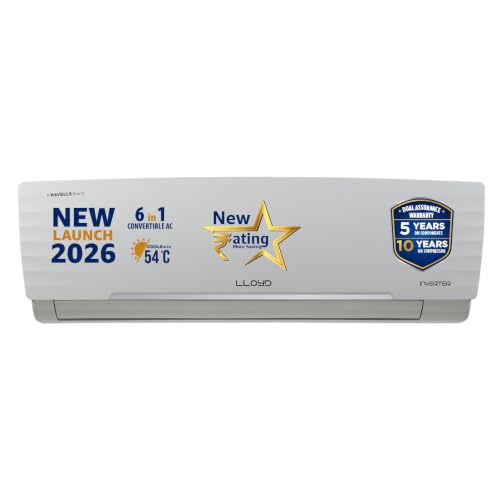
Lloyd 1.5 Ton 5 Star 2026 New Star Rated Inverter Split AC (6-in-1 Convertible, Cools @54°C, Golden Fin, GLS18I5AGGGW)
Efficient and well-filtered on paper — undermined by the field's weakest service and reliability record.
- BEE Star Rating (2026)
- 5 Star (New Star Rated)
- ISEER
- 5.75
- Annual Energy
- 646 kWh/year (2nd lowest)
- Cooling Capacity
- 4.8 kW (cools @54°C)
- Noise Level
- 37 dB
- Refrigerant
- R-32
- Smart
- No Wi-Fi
- Convertible Modes
- 6-in-1
- Filter
- Anti-Viral + PM2.5
- Coating
- Golden Fin (anti-corrosion)
- Warranty
- 1yr / 5yr components / 10yr compressor
- Model
- GLS18I5AGGGW
Lloyd has genuinely good efficiency and anti-viral filtration, but it carries the field's weakest reliability signal: the lowest rating (3.6), a 20% 1-star tail, and a persistent drumbeat of poor-service and faulty-unit complaints. Buy only if the price and filtration outweigh the support risk.
- + Second-best efficiency in the field — 646 kWh/year at ISEER 5.75
- + Anti-viral + PM2.5 filtration — strong air quality for the price
- + Golden Fin anti-corrosion coil + 6-in-1 convertible
- + 5yr components / 10yr compressor warranty on paper
- + Cools even at 54°C
- - Lowest Amazon rating in the field (3.6) with the worst histogram (20% 1-star)
- - Recurring 'Lloyd customer support very bad / no service' complaints
- - Faulty units and water leaks reported
- - Missing power cable / components in box for some buyers
- - No Wi-Fi — and some say cooling is not fast
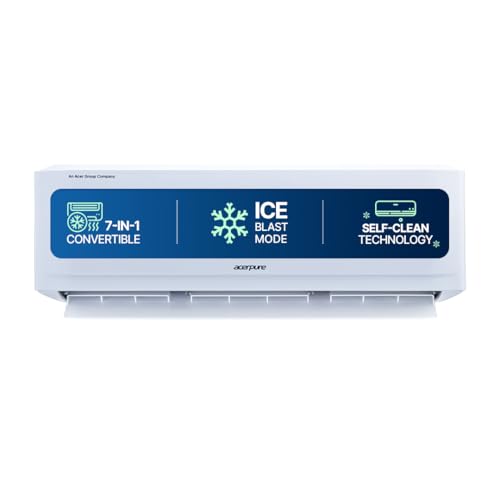
Acerpure Chill Neo 1.5 Ton 5 Star New Star Rated Split AC (7-in-1, Ice Blast, 4-Way Swing, AC5IPG61.5TN5W)
Strong cooling spec and price — undone by an absent India service network and masked recent complaints.
- BEE Star Rating (2026)
- 5 Star (New Star Rated)
- ISEER
- 5.65
- Annual Energy
- 699 kWh/year
- Cooling Capacity
- 5.1 kW (highest capacity)
- Noise Level
- 42 dB (buyers confirm noisy)
- Refrigerant
- R-32
- Smart
- No Wi-Fi
- Convertible Modes
- 7-in-1 + Ice Blast + 4-way
- Filter
- Dust / Pre-Filter
- Condenser
- 100% Copper
- Warranty
- 1yr / 5yr PCB / 10yr compressor
- Model
- AC5IPG61.5TN5W
Acerpure has the highest cooling capacity and a keen price, but it ranks last for a serious reason: it has effectively no service centre network across India, and its clean-looking recent rating is a same-day 5-star burst hiding a steady stream of defective-unit and no-service complaints. Choose it only with eyes open to the support risk.
- + Highest rated cooling capacity in the field — 5.1 kW + Ice Blast
- + Fast cooling genuinely praised by buyers who got a working unit
- + 5yr PCB / 10yr compressor warranty on paper
- + Value price at ₹42,590
- - No Acerpure/Acer service-centre network across India — installation no-shows and warranty risk
- - A steady stream of 1-star verified reviews masked by a same-day 5-star burst
- - Defective 'only fan / no cooling' units reported repeatedly
- - 'Little noisy' confirmed by buyers (42 dB)
- - No Wi-Fi and only a basic dust filter
Understanding the Technologies
Air Purification Compared
Self-Cleaning Technologies
Anti-Corrosion Coatings
Smart Features Compared
Which 1.5 ton 5 star AC to buy
Every pick here is a genuine 2026 BEE 5-star (ISEER 5.60–5.80) — these four stood out for a specific buyer.
IFB CI195SS32SGM3 · ₹42,490
The best all-round 5-star — the lowest running cost (644 kWh/year), inbuilt Wi-Fi with AI and 8-in-1 modes, and the field's healthiest reviews (4.4/253). Buy it unless you must have an AC-specialist service network.
Check Price on Amazon →Midea MAI18SR5R36W0 · ₹38,990
The value champion — a Wi-Fi 5-star with powerful 'cools-like-a-2-ton' cooling and super-silent running for just ₹38,990, if you can accept a thinner review base.
Check Price on Amazon →Cruise CWCVBM-VP3F185 · ₹35,990
The budget standout — genuine ISEER 5.71 efficiency (651 kWh) and 55°C cooling for ₹35,990, if you have a reliable local technician for its small-brand service.
Check Price on Amazon →Hitachi RAS.V518PCDIBT · ₹45,500
The big-room pick — a class-leading 24m air throw and a deep Hitachi service network, worth the paid warranty extension for larger or longer rooms.
Check Price on Amazon →We have reviewed the best ACs across every category — 1 ton to 2.5 ton, 3-star to 5-star, split and window.
See every AC tonnage and type →How to choose a 1.5 ton 5 star AC
-
Why '2026 BEE New Star Rated' matters
BEE revised its ISEER efficiency tables for 2026, so a model's star rating was re-assessed against a tougher benchmark. A '2026 New Star Rated' 5-star genuinely meets the current, stricter standard; an older 5-star SKU still on sale may have earned its rating under the previous, easier table. Every AC in this list is verified as a 2026 New Star Rated 5-star (ISEER 5.60–5.80); older-rating SKUs were rejected. -
5-star vs 3-star: is the premium worth it?
A 5-star 1.5-ton inverter here uses ~644–704 kWh/year versus ~850–920 kWh for a 3-star — roughly 200–250 units saved annually, or about ₹1,600–2,000/year at typical tariffs. If you run the AC 4+ months a year for several years, the 5-star premium (often ₹4,000–8,000) usually pays back. For light or occasional use, a good 3-star can make more sense. -
Read the RECENT reviews, not just the star rating
A high lifetime rating can hide a product that is failing right now. In this research, LG (4.1/862) and Acerpure (4.2/109) both look healthy on their headline rating, yet their most-recent verified buyers report 60% and ~40%+ negative respectively — PCB failures, defective units and no service response. Always scan the newest verified reviews and watch for a wall of same-day 5-star reviews that can bury genuine complaints. -
Service network is half the purchase
An inverter AC is only as good as the support behind it. AC-specialist brands (Daikin, Blue Star, Hitachi, Carrier) have deep India service networks — Blue Star buyers specifically praise fast, professional installation. Appliance-generalists (IFB) and brands with thin or no India AC service (Acerpure/Acer) draw the most 'no engineer, no service' complaints, regardless of how good the machine is. -
ISEER isn't the whole efficiency story
Higher ISEER usually means lower bills — but not always. Panasonic has the highest ISEER (5.80) yet the highest actual annual energy (704 kWh) because of its higher airflow, while IFB's 5.65 ISEER delivers the lowest energy (644 kWh). Compare the annual kWh/year figure, not just the ISEER headline. -
Copper coils, anti-corrosion and what's in the box
Every pick here uses 100% copper coils (easier to repair, better heat transfer than the alloy coils on cheaper units). If you live near the coast or in a humid/polluted city, prioritise an anti-corrosion coil coating (Blue Star Blue Fins, Lloyd Golden Fin, Cruise anti-rust). Also note: the connecting copper pipe is often NOT in the box by design — confirm what your installer will charge for pipe, stabiliser and installation before you buy. -
Installation is the real make-or-break
Across every brand, the loudest complaints are about installation and after-sales, not the AC itself. Units occasionally arrive with missing pipes or wires, and third-party installers may overcharge (₹1,500–2,500 is common for copper piping, stand and stabilizer). Book installation through the brand, inspect the box on delivery, and photograph the unit and accessories before signing. -
Match capacity to your room
A 1.5-ton AC suits roughly 120–180 sq ft (a standard master bedroom or small living room). For larger or sun-facing rooms, or top-floor flats, size up to 2 ton or you'll run the compressor flat-out and lose the efficiency a 5-star buys you.
Frequently asked questions
What does ISEER rating mean in AC and how is it calculated?
What is the ideal AC temperature setting for the lowest electricity bill?
How much electricity does a 1.5 ton 5 star AC consume per month?
Is 1.5 ton AC sufficient for a 12x15 feet bedroom?
What is the difference between TRUE 2026 5-star and 4-star ACs?
What is DustBuster Technology in Panasonic AC?
Why is the IFB CI195SS32SGM3 our top pick?
How much electricity does a 5 star AC save compared to 3 star per year?
What is the price range for 1.5 ton 5 star inverter split AC in India 2026?
Is 1.5 ton 5 star inverter split AC better than 1.5 ton 3 star?
Which one has the lowest electricity bill?
Why does the IFB rank above Panasonic when Panasonic has a higher ISEER?
Which brand has the best after-sales service for ACs?
Do I still need a voltage stabilizer?
Which is the best 1.5 ton 5 star inverter AC in India for 2026?
Why does LG have a great rating but rank low here?
Which 5 star AC is quietest for a bedroom?
Do these ACs come with the copper connecting pipe and installation?
Sources & References
- Standards & Labelling Programme — Room Air Conditioner Star Labels Bureau of Energy Efficiency (BEE), Government of India · 2026 Official BEE star-rating labels for room air conditioners, including the 2026 "New Star Rated" ISEER thresholds referenced throughout this review.
- Room Air Conditioner Labelling Regulations & ISEER Methodology Bureau of Energy Efficiency (BEE), Ministry of Power, Government of India The BEE regulation defining how split and room ACs are rated, including the Indian Seasonal Energy Efficiency Ratio (ISEER) used to set the star bands.
- BEE Star Rating Programme — Standards & Labelling Bureau of Energy Efficiency (BEE), Ministry of Power, Government of India · 2026 Overview of the mandatory star-labelling scheme that governs the 1–5 star ratings shown on every AC in this comparison.
You may also like
More guides and reviews to help you decide.
Best 1.5 ton 3 star inverter split ACs from ₹34,490. Compare IFB, Daikin, Panasonic & more.
Read more →Best 1.5 ton 4 star inverter split AC India 2026: Samsung WindFree, Panasonic Matter, Haier HEXA, LG DUAL, Daikin and Blue Star compared on ISEER, noise.
Read more →Looking for year-round climate control? Compare 4 best 1.5 ton 3 star hot and cold inverter Inverter Split ACs from Daikin, Panasonic, LG & more.
Read more →Best 2 ton 3 star inverter split ACs in India 2026 compared — Daikin, IFB, Samsung, Blue Star & Carrier on 2026 BEE ISEER.
Read more →Best 1 ton 3 star inverter split ACs from ₹27,490. Compare Samsung, IFB, Blue Star, Hitachi, O General & Cruise on 2026 BEE ISEER, kWh, noise, warranty & price.
Read more →Best 1 ton 5 star inverter split ACs in India 2026 — Samsung (WWCD winner), Blue Star, Daikin, LG, O General & more compared on 2026 BEE ISEER, running cost.
Read more →