
PRODUCT REVIEW
Best 2 Ton 3 Star Inverter AC in India 2026
Best 2 ton 3 star inverter split ACs in India 2026 compared — Daikin, IFB, Samsung, Blue Star & Carrier on 2026 BEE ISEER.
 By Naveen Bhavnani
Updated
By Naveen Bhavnani
Updated
As an Amazon Associate we earn from qualifying purchases. We could also earn a fee through some links when you click on them.

2 ton AC picks by price band
Already covered the winner above — here are the picks for specific needs.

IFB 2 Ton 3 Star AI Powered Inverter Split AC (CI223GD32RGM3)

Cruise 2 Ton 3 Star Inverter Split AC 7-Stage Filtration (CWCVBM-VQ1W243)

Samsung 2 Ton 3 Star Bespoke AI Inverter Smart Split AC (AR60H24D13WNNA)
2 ton ACs on ISEER and kWh/yr
How the shortlist stacks up. Scroll sideways on mobile.
| WWCD Score | Product | ISEER | Annual kWh/yr | Convertible | Noise | Amazon Rating | Price | Deal |
|---|---|---|---|---|---|---|---|---|
| 9.5/10 | Daikin FTKL71XV16 | 4.40 | 1238 | Powerful | 32 dB | — (new) | ₹65,900 | Check Price |
| 9.5/10 | IFB CI223GD32RGM3 | 4.35 | 1104 | 8-in-1 | 39 dB | 4.5 (47) | ₹46,490 | Check Price |
| 9.5/10 | Blue Star IA322DXU | 4.38 | 1132 | 5-in-1 | 47 dB | 4.4 (35) | ₹49,850 | Check Price |
| 9.4/10 | Samsung AR60H24D13WNNA | 4.50 | 1085 | 5-step | 26 dB | 4.6 (5) | ₹54,490 | Check Price |
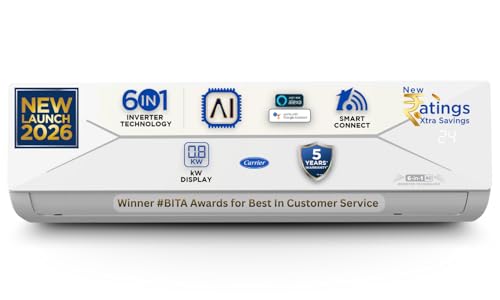
| 9.4/10 | Carrier ESTER EDGE Gxi | 4.35 | 1068 | 6-in-1 | 39 dB | 4.0 (87) | ₹47,490 | Check Price |
| 9.3/10 | LG TS-Q24ENXE | 4.00 | 1220 | AI 6-in-1 | 32 dB | 4.1 (114) | ₹54,490 | Check Price |
| 9.2/10 | Acerpure Chill Neo | 4.37 | 1098 | 7-in-1 | 44 dB | 4.0 (14) | ₹45,990 | Check Price |
| 9.1/10 | Hitachi RAS.G322PCDIBS | 4.30 | ~1090 | Xpandable+ | 32 dB | 3.7 (54) | ₹47,498 | Check Price |
| 9.1/10 | Cruise CWCVBM-VQ1W243 | 3.90 | 1210 | 4-in-1 | 44 dB | 4.3 (78) | ₹37,990 | Check Price |
| 9.1/10 | Godrej AC 2T EC HIC 24J3TS | 4.39 | 1077 | 5-in-1 | 40 dB | 3.4 (15) | ₹42,990 | Check Price |
| 8.8/10 | Voltas 243V Vectra Elite | 3.81 | ~1280 | 4-in-1 | 45 dB | 3.9 (275) | ₹46,500 | Check Price |



Important: BEE Star Rating Changes for 2026
The Bureau of Energy Efficiency (BEE) tightened AC star-rating norms from 1 January 2026. Every pick in this review is a genuine 2026 "New star rated" 3-star, with ISEER verified from each unit's energy label between 3.81 and 4.50 — the best here (Samsung ISEER 4.5, Godrej 4.39, Carrier ~1068 kWh/yr) nearly match older 5-stars.
What this means: a 2026 3-star is more efficient than a 3-star from two years ago — the benchmark moved, the units did not. There is no older rating to "wait out": these are the current 2026 models. An older 5-star is still more efficient than an older 3-star.
Full Transparency: each product below shows its 2026 BEE star rating and ISEER. Understand ISEER & star ratings to compare models yourself.
2 ton 3 star AC reviews — ISEER, noise and cooling
Specs, the honest pros and cons, and who each one is for.
Daikin 2.0 Ton 3 Star Inverter Split AC (FTKL71XV16)
The benchmark brand — Daikin's cooling, efficiency and reliability, at a premium
- BEE Star Rating (2026)
- 3 Star
- ISEER
- 4.40
- Annual Energy
- 1238 kWh/year
- Capacity
- 2 Ton
- Refrigerant
- R-32
- Noise Level
- 32 dB
- Convertible Modes
- Powerful mode
- Condenser
- 100% Copper, DNNS Coating
- Compressor Warranty
- 10 Years
Daikin is widely considered the best AC brand for cooling, quiet operation and long-term reliability, and this unit pairs that pedigree with a top-tier ISEER 4.4. You pay the field's highest price and there are no India reviews on this 2026 SKU yet, but for buyers who prioritise build and cooling over cost, it is the standout pick.
- + Top-tier ISEER 4.4 from the segment's most respected AC brand
- + Benchmark cooling with quiet 32 dB running
- + Best-in-class compressor reliability and build quality
- + 100% copper with patented DNNS anti-corrosion coating and PM2.5 filter
- + Strong well-regarded Daikin service network
- - Most expensive in the field at ₹65,900
- - No verified India reviews yet on this 2026 SKU
- - No Wi-Fi or smart control
- - Higher rated annual consumption (~1238 kWh) as a true 2.0-ton unit
IFB 2 Ton 3 Star AI Powered Inverter Split AC (CI223GD32RGM3)
Best all-round 2-ton 3-star: top rating, strong efficiency, sharp price
- BEE Star Rating (2026)
- 3 Star
- ISEER
- 4.35
- Annual Energy
- 1104 kWh/year
- Capacity
- 2 Ton
- Refrigerant
- R-32
- Noise Level
- 39 dB
- Convertible Modes
- 8-in-1 Flexi
- Condenser
- 100% Copper, Dual Gold Fins
- Compressor Warranty
- 10 Years
Pairs the field's best owner rating with excellent ISEER 4.35 and an 8-in-1 feature set at a mid-market price, making it the most balanced 2-ton 3-star pick for Indian homes.
- + Highest owner rating in the field (4.5) from 47 verified ratings
- + Reviewers praise quick cooling and polite installation
- + Best balance of efficiency
- + features and price at ₹46,490
- + 100% copper with dual gold-fin anti-corrosion coating
- + 8-in-1 flexi modes give the widest capacity control here
- - 47 ratings is moderate — less long-term data than LG or Voltas
- - One verified dead-on-arrival unit reported
- - Brand registration step flagged as fiddly by a reviewer
- - Wi-Fi needs an extra module (not included)
Blue Star 2 Ton 3 Star Inverter Split AC (IA322DXU)
Specialist-brand cooling with top-tier efficiency
- BEE Star Rating (2026)
- 3 Star
- ISEER
- 4.38
- Annual Energy
- 1132 kWh/year
- Capacity
- 2 Ton
- Refrigerant
- R-32
- Noise Level
- 47 dB
- Convertible Modes
- 5-in-1
- Condenser
- 100% Copper, Blue Fins
- Compressor Warranty
- 10 Years
A focused AC-maker's unit with ISEER 4.38, brisk turbo cooling and the field's second-best owner rating; the main caveats are a slightly louder outdoor unit and installer-dependent setup.
- + Second-highest rating (4.4) from 35 verified ratings
- + Reviewers report fast cooling and smooth installation
- + Excellent ISEER 4.38 efficiency
- + 100% copper with blue-fin anti-corrosion coating
- + Built-in Wi-Fi and Alexa/Google voice control
- - Loudest ODU on paper (47 dB) — noise noted by a reviewer
- - One report of missing copper pipe in the box
- - An install-quality complaint (depends on local technician)
- - Service network thinner than LG or Voltas in tier-2 cities
Samsung 2 Ton 3 Star Bespoke AI Inverter Smart Split AC (AR60H24D13WNNA)
The quietest, smartest, most efficient 2-ton 3-star — at a premium
- BEE Star Rating (2026)
- 3 Star
- ISEER
- 4.50
- Annual Energy
- 1085 kWh/year
- Capacity
- 2 Ton
- Refrigerant
- R-32
- Noise Level
- 26 dB
- Convertible Modes
- 5-step Convertible
- Condenser
- 100% Copper
- Warranty
- 5yr Comprehensive + 10yr Compressor
Best-in-class on the numbers — ISEER 4.5, 26 dB and a 5-year comprehensive warranty with full smart control — but its high rating rests on just 5 reviews and stock is thin, so it is the spec-led premium choice rather than the safest bet.
- + Field-best ISEER 4.5 and quietest at 26 dB
- + Smart: Wi-Fi
- + voice control and AI auto energy saving
- + 5-year comprehensive product warranty
- + 5-step convertible for precise capacity control
- + Highest rating in the field (4.6) albeit from few buyers
- - Only 5 India ratings — reliability not yet well validated
- - Only 1 unit left in stock at time of research
- - Premium price (₹54,490)
- - One review reported a 2025 indoor unit vs a 2026 outdoor unit
Carrier 2 Ton 3 Star Wi-Fi Flexicool Inverter Split AC (ESTER EDGE Gxi, CAI24EE3R36W0)
Smart Wi-Fi cooling with the lowest running cost on paper
- BEE Star Rating (2026)
- 3 Star
- ISEER
- 4.35
- Annual Energy
- 1068 kWh/year
- Capacity
- 2 Ton
- Refrigerant
- R-32
- Noise Level
- 39 dB
- Convertible Modes
- 6-in-1
- Condenser
- 100% Copper
- Compressor Warranty
- 10 Years (+4yr optional)
The pick for smart-home buyers: Wi-Fi geo-fencing, the field's lowest rated consumption and a large review base, though a minority report noise and uneven cooling.
- + Lowest rated annual consumption in the field (1068 kWh)
- + Wi-Fi with geo-fencing and a smart energy display
- + Solid 4.0 rating from a large 87-review base
- + 6-in-1 convertible with a 100% copper condenser
- + Optional 4-year extended warranty
- - A few reviewers reported noise and weak-cooling units
- - Mixed cooling experience versus the best in class
- - Extended warranty needs paid registration
- - Geo-fencing and app setup can be fiddly
LG 2.0 Ton 3 Star DUAL Inverter Split AC (TS-Q24ENXE)
The most-validated, proven dual-inverter workhorse
- BEE Star Rating (2026)
- 3 Star
- ISEER
- 4.00
- Annual Energy
- 1220 kWh/year
- Capacity
- 2 Ton
- Refrigerant
- R-32
- Noise Level
- 32 dB
- Convertible Modes
- AI 6-in-1
- Condenser
- 100% Copper
- Compressor Warranty
- 10 Years
If track record matters most, LG's DUAL Inverter has the deepest review base (114 ratings) and proven cooling at 45°C — you trade some 2026-era efficiency (ISEER 4.0) for reliability and the widest service network.
- + Most-validated unit here: 4.1 rating from 114 ratings
- + Reviewers confirm fast quiet cooling even at 45°C
- + Proven durable LG DUAL Inverter platform
- + HD anti-virus filter and AI 6-in-1 modes
- + India's widest after-sales service network
- - Lowest efficiency among the picks (ISEER 4.0)
- - Priciest tier (₹54,490)
- - Isolated reports of a missing copper pipe and a remote failure
- - Most reviews are 2024-25 (established not newest model)
Acerpure Chill Neo 2 Ton 3 Star Inverter Split AC (AC5IPG62TN3W)
Budget-friendly efficiency with rapid Ice Blast cooling
- BEE Star Rating (2026)
- 3 Star
- ISEER
- 4.37
- Annual Energy
- 1098 kWh/year
- Capacity
- 2 Ton
- Refrigerant
- R-32
- Noise Level
- 44 dB
- Convertible Modes
- 7-in-1
- Condenser
- 100% Copper
- Compressor Warranty
- 10 Years
A newcomer that punches above its price — ISEER 4.37 and strong early cooling praise at ₹45,990 — held back only by a thin review base and a smaller service network.
- + High ISEER 4.37 (~1098 kWh/yr) for low bills
- + Ice Blast mode cools the room fast
- + 7-in-1 convertible with a 100% copper condenser
- + Lowest price among the higher-efficiency picks
- + Positive early reviews on cooling and power savings
- - Only 14 India ratings — limited long-term validation
- - Acerpure is a newer brand with a smaller service footprint
- - 44 dB — not the quietest
- - No Wi-Fi or smart control
Hitachi 2 Ton 3 Star Inverter Split AC EEV Precision Cool (RAS.G322PCDIBS)
Powerful long-throw cooling, let down by service niggles
- BEE Star Rating (2026)
- 3 Star
- ISEER
- 4.30
- Annual Energy
- ~1090 kWh/year
- Capacity
- 2 Ton
- Refrigerant
- R-32
- Noise Level
- 32 dB
- Convertible Modes
- Xpandable Plus
- Condenser
- 100% Copper, Nano Tech
- Warranty
- 1yr standard (+4yr optional)
Hitachi's EEV precision cooling and 24m air throw are genuinely strong for large rooms, but recurring water-leakage and installation complaints pull the owner rating to 3.7 — buy it for cooling, budget for careful installation.
- + High ISEER 4.3 with quiet 32 dB running
- + EEV Precision Cool and 24m air throw cool large rooms fast
- + Ice Clean and Octa Sensor feature set
- + Trusted Hitachi cooling engineering
- + 100% copper coil with Nano Tech coating
- - 3.7 owner rating — below the field average
- - Multiple reports of indoor-unit water leakage within weeks
- - Installation-overcharge complaints beyond Amazon's credit
- - Only 1-year standard warranty unless extended for a fee
Cruise 2 Ton 3 Star Inverter Split AC 7-Stage Filtration (CWCVBM-VQ1W243)
Most cooling per rupee — the value champion
- BEE Star Rating (2026)
- 3 Star
- ISEER
- 3.90
- Annual Energy
- 1210 kWh/year
- Capacity
- 2 Ton
- Refrigerant
- R-32
- Noise Level
- 44 dB
- Convertible Modes
- 4-in-1
- Condenser
- 100% Hi-Grooved Copper
- Compressor Warranty
- 10 Years
At ₹37,990 with a 4.3 rating from 78 buyers, Cruise delivers the field's best cooling-per-rupee and strong filtration; you accept a lower ISEER (higher bills) and a smaller service brand in exchange.
- + Lowest price in the field by a clear margin (₹37,990)
- + Reviewers praise powerful cooling for the money (4.3/78)
- + 7-stage and PM2.5 filtration for air quality
- + 100% hi-grooved copper with anti-rust coating
- + Several reviewers cite good Cruise customer service
- - Lower ISEER 3.9 — higher running cost than the 2026 picks
- - Some reports of paid warranty service and installer overcharge
- - One complaint of limited cooling and noise
- - Smaller brand than the majors
Godrej 2 Ton 3 Star 5-in-1 Inverter Split AC (AC 2T EC HIC 24J3TS WA)
Most efficient on paper with the best warranty — if service cooperates
- BEE Star Rating (2026)
- 3 Star
- ISEER
- 4.39
- Annual Energy
- 1077 kWh/year
- Capacity
- 2 Ton
- Refrigerant
- R-32
- Noise Level
- 40 dB
- Convertible Modes
- 5-in-1
- Condenser
- Copper, Blue Fin
- Warranty
- 5yr Comprehensive + 10yr Compressor
On paper this is the value-efficiency leader — ISEER 4.39, 1077 kWh and a 5-year comprehensive warranty at ₹42,990 — but a 3.4 rating driven by installation and service complaints means you are betting on Godrej's after-sales coming through.
- + Near-best ISEER 4.39 (~1077 kWh/yr) — very efficient
- + 5-year comprehensive product warranty (rare)
- + 5-in-1 convertible with 52°C heavy-duty cooling
- + Blue-fin copper coil
- + Low price for the efficiency on offer (₹42,990)
- - Low 3.4 owner rating — the field's weakest
- - Repeated complaints about Godrej installation and service support
- - Reports of faulty units and an indoor-unit leakage
- - Only 15 ratings — limited validation
Voltas 243V Vectra Elite 2 Ton 3 Star Inverter Split AC
Mass-market Voltas reach and summer cooling — at an efficiency cost
- BEE Star Rating (2026)
- 3 Star
- ISEER
- 3.81
- Annual Energy
- ~1280 kWh/year
- Capacity
- 2 Ton
- Refrigerant
- R-32
- Noise Level
- 45 dB
- Convertible Modes
- 4-in-1
- Condenser
- 100% Copper
- Compressor Warranty
- 10 Years
Voltas brings the widest service reach and proven 52°C cooling with the deepest review base, but the lowest ISEER in the field and recurring packaging/warranty gripes make it a convenience pick rather than a value-efficiency one.
- + High-ambient 52°C cooling for harsh Indian summers
- + Largest most-accessible Voltas service network
- + Most-reviewed unit in the field (275 ratings)
- + 100% copper condenser
- + Proven simple 4-in-1 platform
- - Lowest ISEER (3.81) — highest running cost in the field
- - Recurring 'copper pipe missing in box' complaints
- - Warranty-terms confusion reported by buyers
- - Basic feature set with no smart control and 45 dB noise
Understanding the Technologies
Convertible / Flexi Modes
Anti-Corrosion Coatings
Smart & Air-Quality Features
Which 2 ton 3 star AC to buy
Every pick here is a genuine 2026 BEE 3-star (ISEER 3.81–4.50) — these four stood out for a specific buyer.
Daikin FTKL71XV16 · ₹65,900
The safest all-round choice — benchmark Daikin cooling, quiet 32 dB running, DNNS anti-corrosion copper and top-tier ISEER 4.4. Buy it if you want the best-built, best-serviced unit and don't mind paying the most.
Check Price on Amazon →IFB CI223GD32RGM3 · ₹46,490
The most AC per rupee — the field-best 4.5 owner rating, ISEER 4.35 and an 8-in-1 flexi mode, all under ₹47,000. The balanced pick for most large rooms.
Check Price on Amazon →Cruise CWCVBM-VQ1W243 · ₹37,990
The value champion — powerful cooling, 7-stage filtration and a 4.3 rating for ₹37,990, if you can accept a lower ISEER 3.9 and a smaller service network.
Check Price on Amazon →Samsung AR60H24D13WNNA · ₹54,490
The spec leader — quietest (26 dB), most efficient (ISEER 4.5), full Wi-Fi/voice control and a 5-year comprehensive warranty. Best if you want the smartest unit and are an early adopter.
Check Price on Amazon →We have reviewed the best ACs across every category — 1 ton to 2.5 ton, 3-star to 5-star, split and window.
Compare every AC size and rating →How to choose a 2 ton 3 star AC
-
Why a 3-star (not 5-star) 2-ton AC can be the smart buy
A 2-ton AC is for large rooms (180-300 sq ft) or hot climates. The 3-star variant costs noticeably less up front than a 5-star and still uses an inverter compressor. If your daily run-time is moderate (4-6 hours) or you run it mainly in peak summer, the lower purchase price often outweighs the extra electricity versus a 5-star. For 8+ hours/day year-round use, step up to a higher star rating. Within 3-star, chase the highest ISEER you can — the best 2026 models here reach ISEER ~4.4-4.5, nearly closing the gap to older 5-stars. -
Read ISEER and annual units, not just the star label
From 2026 the BEE tightened its rating table, so a '3-star' today is more efficient than a 3-star from two years ago. Compare the ISEER number and the annual energy consumption (kWh/year) on the spec sheet. In this field they range from ISEER 3.81 (~1280 kWh) up to ISEER 4.5 (~1085 kWh). At roughly ₹8/unit, that ~200 kWh/year gap is about ₹1,600/year — meaningful over a 10-year life. -
Convertible modes — useful, but don't overpay for the count
4-in-1, 5-in-1, 6-in-1 and 8-in-1 convertible modes let you cap the compressor at a fraction of capacity (e.g. run a 2-ton as 1.2-ton) to save power in milder weather, or overdrive for fast cooling. More steps add flexibility, but the jump from 4 to 8 modes matters far less than ISEER and reliability. Treat mode-count as a tiebreaker, not a headline. -
Copper coil, anti-corrosion fins and the warranty that matters
Insist on 100% copper (all the picks here qualify) — it cools better and is far easier to repair than aluminium. Anti-corrosion fin coatings (blue fin, gold fin, DNNS) extend coil life, especially in coastal/humid areas. On warranty, the headline 10-year compressor is standard; what varies is product/PCB cover. A 5-year comprehensive warranty (Samsung, Godrej, Blue Star here) is genuinely valuable — but only if the brand's service actually shows up, so weigh it against owner reviews. -
Installation is where most complaints come from — plan for it
Across nearly every brand in this research, the loudest complaints were not about the AC but about installation: missing copper pipe in the box, technicians charging extra for piping/labour beyond the Amazon installation credit, and crooked or delayed installs. Budget ₹1,500-3,500 for extra copper piping and a stabiliser, book installation through the brand's authorised service (not a random local technician) to protect your warranty, and inspect the box contents on delivery. -
High-ambient cooling for Indian summers
Look for a rated cooling temperature of 50-55°C — it tells you the unit will keep cooling when the outdoor temperature spikes, instead of tripping or losing capacity. Most models here are rated to 52-55°C. Pair that with long air-throw (Hitachi's 24m, for example) for large rooms, and a turbo/powerful-cool mode for quick pull-down when you walk in.
Frequently asked questions
How much electricity does a 2 ton AC consume per hour in units?
Is 2 ton AC too big for a 150 sq ft bedroom?
Should I buy 3 star now or wait for new 2026 models?
How much electricity bill increase should I expect with 2 ton 3 star AC?
Do I need a stabilizer for these 2 ton ACs?
What is the maximum room size a 2 ton AC can cool effectively?
What is the maximum copper pipe length for a 2 ton split AC installation?
Can a 2 ton AC cool a 300 sq ft hall or living room?
What is the price range for 2 ton 3 star inverter split AC in India 2026?
Is 2 ton 3 star inverter split AC better than 2 ton 5 star AC?
Which 2 ton 3 star AC is the most energy-efficient?
Is R-32 refrigerant safe and good for these ACs?
What does the 10-year compressor warranty actually cover?
Is Wi-Fi or smart control worth it on a 2 ton 3 star AC?
You may also like
More guides and reviews to help you decide.
Find the best 2 ton 5 star inverter split AC India has in 2026. Compare O General, Blue Star, Carrier & more.
Read more →Only 2 models exist: Panasonic Wi-Fi Matter vs Daikin FTKL71UV16M. Expert comparison of 2 ton 4 star inverter split ACs with ISEER, features & buying guide.
Read more →11 best 1.5 ton 5 star inverter split ACs in India 2026 compared — IFB (WWCD winner, 644 kWh/yr), Midea value pick, Cruise budget, Carrier, Hitachi.
Read more →Best 1.5 ton 4 star inverter split AC India 2026: Samsung WindFree, Panasonic Matter, Haier HEXA, LG DUAL, Daikin and Blue Star compared on ISEER, noise.
Read more →Best 1 ton 5 star inverter split ACs in India 2026 — Samsung (WWCD winner), Blue Star, Daikin, LG, O General & more compared on 2026 BEE ISEER, running cost.
Read more →Best 1.5 ton 3 star inverter split ACs from ₹34,490. Compare IFB, Daikin, Panasonic & more.
Read more →