
PRODUCT REVIEW
Best Stabilizer in India 2026
Best stabilizer for 1.5 ton AC in India 2026. Compare V-Guard, Microtek & more with voltage range, warranty, and prices. Covers inverter and non-inverter ACs.
 By Naveen Bhavnani
Updated
By Naveen Bhavnani
Updated
As an Amazon Associate we earn from qualifying purchases. We could also earn a fee through some links when you click on them.

Stabilizer picks by KVA rating
Already covered the winner above — here are the picks for specific needs.
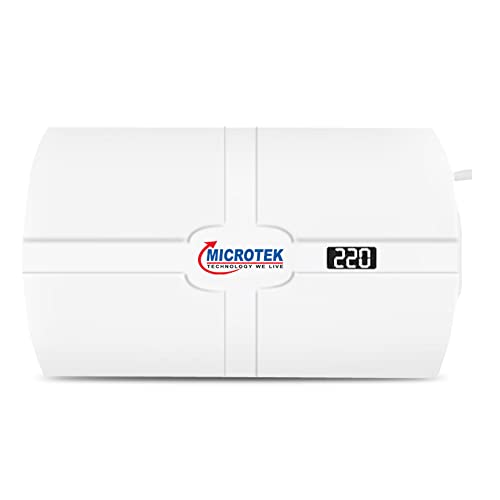
Microtek Smart EM4160+ Digital Display Voltage Stabilizer

Everest EWD 400-N Voltage Stabilizer for Up to 1.5 Ton AC

V-Guard iMagno 410 NX AC Stabilizer for 1.5 Ton Inverter AC
Stabilizer voltage ranges compared
How the shortlist stacks up. Scroll sideways on mobile.
| Stabilizer | Voltage Range | AC Type | Warranty | Display | Price | Deal |
|---|---|---|---|---|---|---|
| V-Guard iD4 Ace 5540 | 130-280V | Inverter AC | 3 Years | Digital + LED Ring | ₹6,038 | Check Price |
| Microtek Smart EM4160+ | 160-285V | Inverter AC | 3 Years | Digital + LED | ₹2,550 | Check Price |
| V-Guard iMagno 410 NX | 170-270V | Inverter AC | 2 Years | Digital | ₹2,839 | Check Price |
| Everest EWD 400-N | 130-270V | All AC Types | 5 Years | Digital | ₹3,198 | Check Price |
| Voltas VA4130 | 130-300V | All AC Types | 3 Years | Digital | ₹4,299 | Check Price |
AC stabilizer reviews: voltage range, delay and warranty
Specs, the honest pros and cons, and who each one is for.
V-Guard iD4 Ace 5540 AC Stabilizer for 1.5 Ton Inverter AC
- Capacity
- 4 KVA
- AC Type
- 1.5 Ton Inverter AC
- Input Range
- 130V - 280V
- Output
- 230V ± 1%
- Display
- Digital + LED Ring
- Time Delay
- ITDS (3 min)
- EMI Filter
- Yes
- Warranty
- 3 Years Onsite
The V-Guard iD4 Ace 5540 is our top pick for the best overall AC stabilizer for 1.5 ton use in India. With over 4,000 verified ratings on Amazon India, it is the most-reviewed and highest-rated stabilizer in this segment. The standout feature is its 130-280V working range — the widest of any V-Guard model — providing protection across the full spectrum of Indian power fluctuations, from extreme low voltage in rural UP and Bihar to high voltage surges. The colour-changing LED ring provides instant visual feedback: green for normal, orange for borderline, red for danger — you can spot voltage issues from across the room. The EMI filter suppresses electromagnetic interference that can cause compressor malfunctions in sensitive inverter ACs. V-Guard's nationwide onsite warranty service means a technician comes to your door if anything goes wrong within 3 years.
- + Widest voltage protection range (130-280V) handles extreme fluctuations across India
- + colour-changing LED rings give real-time visual voltage status
- + Intelligent Time Delay System protects AC compressor from restart damage
- + EMI filter suppresses electrical noise
- + 3-year onsite warranty from India's most trusted stabilizer brand
- + over 4,000 positive ratings on Amazon India
- - Most expensive at Rs.6,038
- - larger design than budget options
- - no double booster for extreme low voltage below 130V
Microtek Smart EM4160+ Digital Display Voltage Stabilizer
- Capacity
- 4 KVA
- AC Type
- Inverter AC Optimized
- Input Range
- 160V - 285V
- Output
- 220V ± 5%
- Colour
- White (Modern)
- Display
- Digital + Smart LED
- Time Delay
- Yes
- Warranty
- 3 Years
The Microtek Smart EM4160+ is the best budget stabilizer for 1.5 ton AC in India — delivering solid protection at just Rs.2,550 with over 4,700 ratings. It has the second-widest upper range in our list at 285V, providing excellent overvoltage protection. The modern white colour blends seamlessly with contemporary AC units and interiors, unlike older grey stabilizer models. This model is specifically optimised for inverter AC operation — its voltage regulation algorithm handles the variable frequency compressor loads of modern inverter ACs. The 3-year warranty at this price point is exceptional — most budget stabilizers only offer 1 year. Microtek is India's second-largest stabilizer brand with strong service coverage in North and Central India.
- + Most affordable at Rs.2,550 with 4,700+ ratings
- + wider upper range (285V)
- + 3-year warranty
- + Microtek is India's 2nd largest stabilizer brand
- + clean white design suits modern interiors
- + thermal overload protection prevents internal damage
- - Lower voltage range starts at 160V — not suitable for extreme low voltage areas
- - no EMI filter
- - service quality varies by city
V-Guard iMagno 410 NX AC Stabilizer for 1.5 Ton Inverter AC
- Capacity
- 4 KVA
- AC Type
- 1.5 Ton Inverter AC
- Input Range
- 170V - 270V
- Output
- 220-240V
- Generation
- NX (Latest)
- Display
- Digital
- Time Delay
- ITDS
- Warranty
- 2 Years Onsite
The V-Guard iMagno 410 NX is the latest generation entry-level V-Guard stabilizer — upgraded from the older non-NX model with a refreshed design and improved energy efficiency. At Rs.2,839, it delivers the core V-Guard promise — reliable voltage protection backed by India's most trusted stabilizer brand — at a price that is Rs.3,199 less than the flagship iD4 Ace. The NX generation design is more compact and wall-mountable, keeping it out of the way and preventing tripping hazards. The digital display shows real-time input and output voltage. V-Guard's national service network means pan-India warranty support is available. This is the right choice if you specifically want a V-Guard product but don't want to spend on the premium iD4 Ace.
- + Latest NX generation V-Guard design
- + trusted V-Guard brand at mid-range price
- + compact wall-mountable form factor
- + energy-efficient reduces standby power consumption
- + digital display
- + pan-India V-Guard service support
- - Narrowest range (170-270V) — not for extreme fluctuation areas
- - only 2-year warranty (shortest in list)
- - no EMI filter
- - for inverter ACs only
Everest EWD 400-N Voltage Stabilizer for Up to 1.5 Ton AC
- Capacity
- 4 KVA
- AC Compatibility
- All Types
- Input Range
- 130V - 270V
- Booster
- Double Booster
- Display
- Digital
- Time Delay
- ITDS
- Compatible
- Inverter+Split+Window
- Warranty
- 5 Years
The Everest EWD 400-N has two standout features no other stabilizer in our list can match — a 5-year warranty and a double booster for extreme low voltage. Most stabilizers offer 2-3 years; Everest's 5-year coverage provides genuine long-term peace of mind. The double booster means the stabilizer can maintain output voltage even when input drops as low as 130V — handling extreme low-voltage scenarios that occur in rural areas and industrial zones. Unlike the V-Guard iMagno or Microtek Smart (inverter-only models), the EWD 400-N is fully compatible with both inverter and non-inverter ACs including window ACs — making it the most versatile option. The digital display provides real-time voltage monitoring. If your area sees frequent power cuts and very low voltage, this is the stabilizer to buy.
- + Industry-best 5-year warranty
- + double booster handles extreme low voltage from 130V
- + works with both inverter and non-inverter ACs
- + established Everest brand
- + digital display for real-time monitoring
- - Upper range only 270V — lower than Microtek's 285V
- - slightly bulkier design
- - brand less well-known than V-Guard
- - fewer Amazon reviews than competitors
Voltas VA4130 4KVA Voltage Stabilizer for 1.5 Ton AC
- Capacity
- 4 KVA
- AC Type
- Up to 1.5 Ton
- Input Range
- 130V - 300V
- Brand Trust
- Tata Group
- Display
- Digital
- Time Delay
- Yes
- Warranty
- 3 Years
The Voltas VA4130 stands out with the widest voltage range of any stabilizer in this entire review — a remarkable 130-300V operating range. The 300V upper limit is the highest available, providing exceptional protection against over-voltage which is particularly common during off-peak night hours in some areas. Voltas is a Tata Group company — the same conglomerate behind some of India's most reliable brands — and happens to be India's largest AC manufacturer itself. This means Voltas understands exactly what a stabilizer needs to do for an AC, designing the VA4130 from an AC-first perspective. The 3-year warranty at a competitive price point adds confidence. For anyone who wants maximum voltage protection range backed by an iconic Indian brand, this is the new entrant to watch.
- + Widest voltage range of any stabilizer in this list (130-300V)
- + backed by Tata/Voltas brand known for ACs
- + 3-year warranty
- + competitive pricing
- + digital display
- - New entrant in stabilizer market — Voltas known for ACs not stabilizers
- - fewer reviews as newer product
- - stabilizer service network not yet as proven as V-Guard
Which AC stabilizer to buy
Here is who each pick is for, based on the comparison above.
V-Guard iD4 Ace 5540 AC Stabilizer for 1.5 Ton Inverter AC · ₹6,038
Widest V-Guard range 130-280V + EMI filter + colour LED — 4,000+ reviews
Check Price on Amazon →Microtek Smart EM4160+ Digital Display Voltage Stabilizer · ₹2,550
Microtek Smart at Rs.2,550 with 4,700+ ratings and 3-year warranty
Check Price on Amazon →Everest EWD 400-N Voltage Stabilizer for Up to 1.5 Ton AC · ₹3,198
Everest 5-year warranty + double booster + works with all AC types
Check Price on Amazon →V-Guard iMagno 410 NX AC Stabilizer for 1.5 Ton Inverter AC · ₹2,839
V-Guard NX generation design at mid-range price for inverter ACs
Check Price on Amazon →Our AC roundup ranks split and window ACs by tonnage and star rating, and covers when an inverter AC still needs a stabilizer.
Find the right AC for your home →How to choose an AC stabilizer
-
Do You Actually Need a Stabilizer for Your 1.5 Ton AC?
- **Modern inverter ACs (2018+)** from Daikin, Voltas, LG, Samsung, Hitachi have built-in voltage protection for 145V-290V - **You may not need one** if your area has mild fluctuations within 145V-290V and you own a 2019+ inverter AC - **You definitely need one** if voltage drops below 145V frequently — common in rural areas, tier-3 cities, and industrial zones - **Non-inverter and older ACs** almost always need a stabilizer — they lack built-in protection - A stabilizer costs Rs.2,500-6,000 vs Rs.35,000-60,000 for compressor replacement — the insurance value alone is worth it -
4 KVA vs 5 KVA Stabilizer — Which Capacity Do You Need?
- **1.5 ton AC peak load:** approximately 1.5-2 kW - **4 KVA (4,000 VA):** provides 2-2.5x headroom — sufficient for a single 1.5 ton AC - **All five stabilizers in our list** are 4 KVA rated (industry standard for 1.5 ton) - **Never use 3 KVA** with a 1.5 ton AC — only 1.5x headroom causes overheating and premature failure - **5 KVA works** but adds unnecessary cost and size for a single AC - **Choose 5 KVA** only if connecting other appliances alongside the AC (lights, fan) -
Voltage Range: The Most Critical Specification
- **Metro cities** (Bangalore, Hyderabad, Mumbai, Delhi): typically 180V-240V - **Rural/industrial areas** (UP, Bihar, Rajasthan, rural Maharashtra): can drop to 140V-160V in peak summer - **North-eastern states:** extreme fluctuations between 130V-270V - **Voltas VA4130:** widest range at 130-300V - **V-Guard iD4 Ace 5540:** 130-280V — covers virtually every scenario in India - **Microtek Smart EM4160+:** 160-285V — covers 95% of urban India - Check your voltage during summer afternoons and evenings to pick the right model -
Time Delay System: Why It Matters for Your AC Compressor
- **The problem:** when power restores after a cut, the compressor tries to restart against residual high-pressure refrigerant — causing severe mechanical stress - **ITDS (Intelligent Time Delay System):** introduces a 3-minute delay before reconnecting power, letting refrigerant pressure equalize - **Impact:** can add 3-5 years to your compressor life in areas with frequent power cuts - **All five stabilizers in our list** include ITDS - **Non-negotiable:** never use a stabilizer without ITDS for an air conditioner -
Brand Service Network: Who Provides the Best After-Sales?
- **V-Guard:** widest network — 1,300+ towns including tier-2 and tier-3 cities, dedicated stabilizer service team - **Microtek:** strong in North and Central India — Delhi NCR, UP, Rajasthan - **Everest:** good coverage in South India (Karnataka, Tamil Nadu, AP) but limited in North - **Voltas (Tata):** massive AC service network but stabilizer service still developing - **Tier-1 cities:** all brands provide comparable quality - **Tier-2 and smaller towns:** V-Guard has the clear advantage -
Avoid Stabilizers Below Rs.1,500
- Unknown brands sell 4 KVA AC stabilizers for Rs.800-1,500 on Amazon and Flipkart - These typically use **undersized transformers** and **lack proper ITDS** - Can damage your AC compressor on power restoration - **Rs.2,550 Microtek Smart EM4160+** is the minimum price point we recommend - Saving Rs.1,000 on a stabilizer and risking a Rs.15,000 compressor repair is poor math
Frequently asked questions
Do I need a stabilizer for my 1.5 ton inverter AC?
Which is better — V-Guard or Microtek stabilizer for 1.5 ton AC?
What is the correct KVA size for a 1.5 ton AC stabilizer?
Should I connect my AC directly to the stabilizer or via the socket?
How do I know if my stabilizer is working correctly?
Can I use one stabilizer for multiple ACs?
What is the normal household voltage range in India?
What is ITDS (Intelligent Time Delay System) in a voltage stabilizer?
Can low voltage damage an AC compressor?
You may also like
More guides and reviews to help you decide.
11 best 1.5 ton 5 star inverter split ACs in India 2026 compared — IFB (WWCD winner, 644 kWh/yr), Midea value pick, Cruise budget, Carrier, Hitachi.
Read more →Best 1.5 ton 4 star inverter split AC India 2026: Samsung WindFree, Panasonic Matter, Haier HEXA, LG DUAL, Daikin and Blue Star compared on ISEER, noise.
Read more →Best 1.5 ton 3 star inverter split ACs from ₹34,490. Compare IFB, Daikin, Panasonic & more.
Read more →Looking for year-round climate control? Compare 4 best 1.5 ton 3 star hot and cold inverter Inverter Split ACs from Daikin, Panasonic, LG & more.
Read more →The best window ACs in India for 2026 — compare Carrier, Voltas, Panasonic & more. Picks for every budget.
Read more →Best 1 ton 3 star inverter split ACs from ₹27,490. Compare Samsung, IFB, Blue Star, Hitachi, O General & Cruise on 2026 BEE ISEER, kWh, noise, warranty & price.
Read more →